
Portrait · Perception · c. 1402
Motion · Ambient plate · Generated interpretation
The Flower Is Not the Face
A playwright tells actors that the mask must be worn until a different kind of looking becomes possible.
- Yamato sarugaku, in the orbit of the Ashikaga court
- Muromachi Japan
- 35.01°N 135.77°E
The face is wood. Where do you place the one who would look back?
Listen · Eve
0:00 / —:—
Around 1402, an actor in his late thirties writes a secret book for his own house. His name is Zeami Motokiyo. His father, Kan’ami, had led a Yamato sarugaku troupe: players from the Nara hills who danced, mimed, and sang for shrine and court. In 1374, when Zeami was a boy, they performed before the shogun Ashikaga Yoshimitsu. Patronage followed. Nō as a high art has that door. The book does not. It is for the family.
The treatise is Fūshikaden, Teachings on Style and the Flower, also called Kadensho. Zeami says it transmits his father’s teaching. It is the first known treatise on this drama in Japan. English readers often meet it through J. Thomas Rimer and Yamazaki Masakazu, On the Art of the Nō Drama (Princeton, 1984). The Japanese is the source. Later essays, Kakyō and Kyūi, develop ranks of the flower. They are not one pamphlet, and they are not yet written.
Nō is not a theory of consciousness. It is a craft of appearing. The actor studies age by age. He must master basic roles: the warrior, the woman, the old person. Monomane is imitation, the copying of a form until the form can carry a life. Hana, the flower, is the freshness and fitness of that appearing: not a smile, not a personality. A child has a flower that age takes. An adult must grow another, or the stage goes stale. An actor who believes he already possesses the flower will lose it.
A mask, in this practice, is not a disguise laid over a real face. It is the face the play requires, worn until the body consents. The spectator sits in a dim house and looks at wood. If the wearing is sufficient, someone in the dark feels a person looking back. Zeami is practical about that shiver. He is not writing a psychology of the spectator. Yūgen is a rank of appearance, the dim and the withheld, not a mood board and not a European unconscious.
The essence of yūgen is true beauty and gentleness.
What happened next belongs to another shogun. In 1434 Ashikaga Yoshinori exiled Zeami to the island of Sado. He returned after that shogun’s death. The secret book had been for descendants. The flower, in his own teaching, was never a possession. The exile is not a moral attached to the treatise. It is the life that continued after the ink.
Fūshikaden, main form around 1400–1402, with later additions sometimes dated toward 1418. Britannica: born 1363, died 1443. Performance before Yoshimitsu, 1374. Exile to Sado, 1434. Rimer and Yamazaki 1984 for the English door.
Western readers want the mask to be a metaphor for persona. Zeami is more practical: training is a way of looking from inside a form. That looking can be described without importing a European unconscious. Whether the spectator’s shiver is the actor’s awareness, the role’s, or the house’s, is not a question the treatise is trying to answer in our terms.
A word
yūgen
Japanese. Depth, the dim, the withheld. In Zeami, a rank of appearance, not a synonym for mystery. English “grace” is a translator’s compromise.
Distant echoes
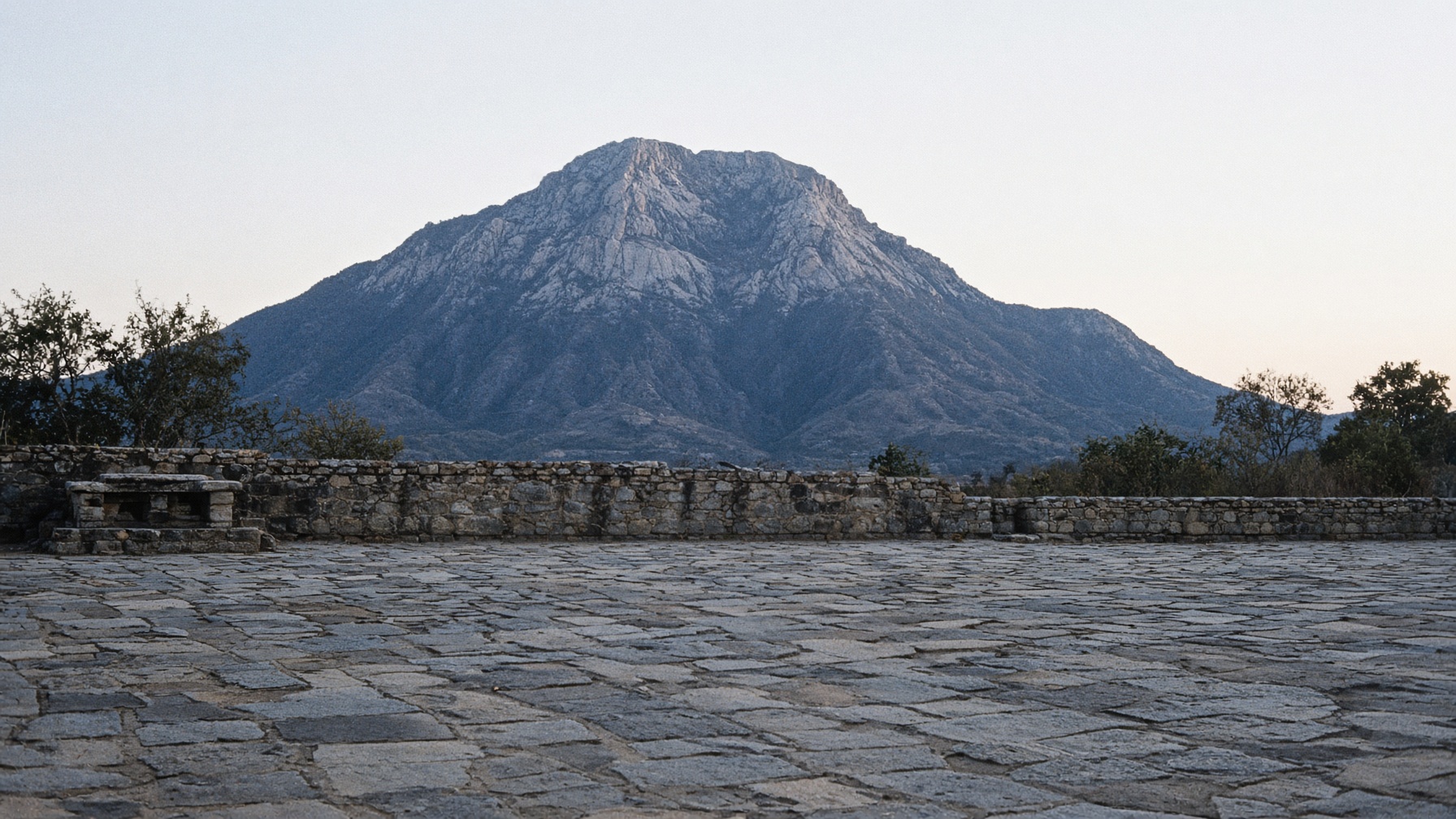
Echo
Colonial South India · Madurai, then Arunachala
Who is asking?
Ramana turns the look inward until the looker thins. Zeami turns the look into a role until a different flower appears. Two trainings. Not one awakening.
One question remains
Perception · What does sensing give us?
When a wooden face is worn well enough that someone in the dark feels seen, whose seeing is that?