
Science · Mind & body · 1888
The Line That Would Not Join
A histologist in Barcelona draws what the silver stain shows: endings. The rival theory wanted a net.
- Barcelona, then Madrid
- Restoration Spain
- 41.39°N 2.17°E
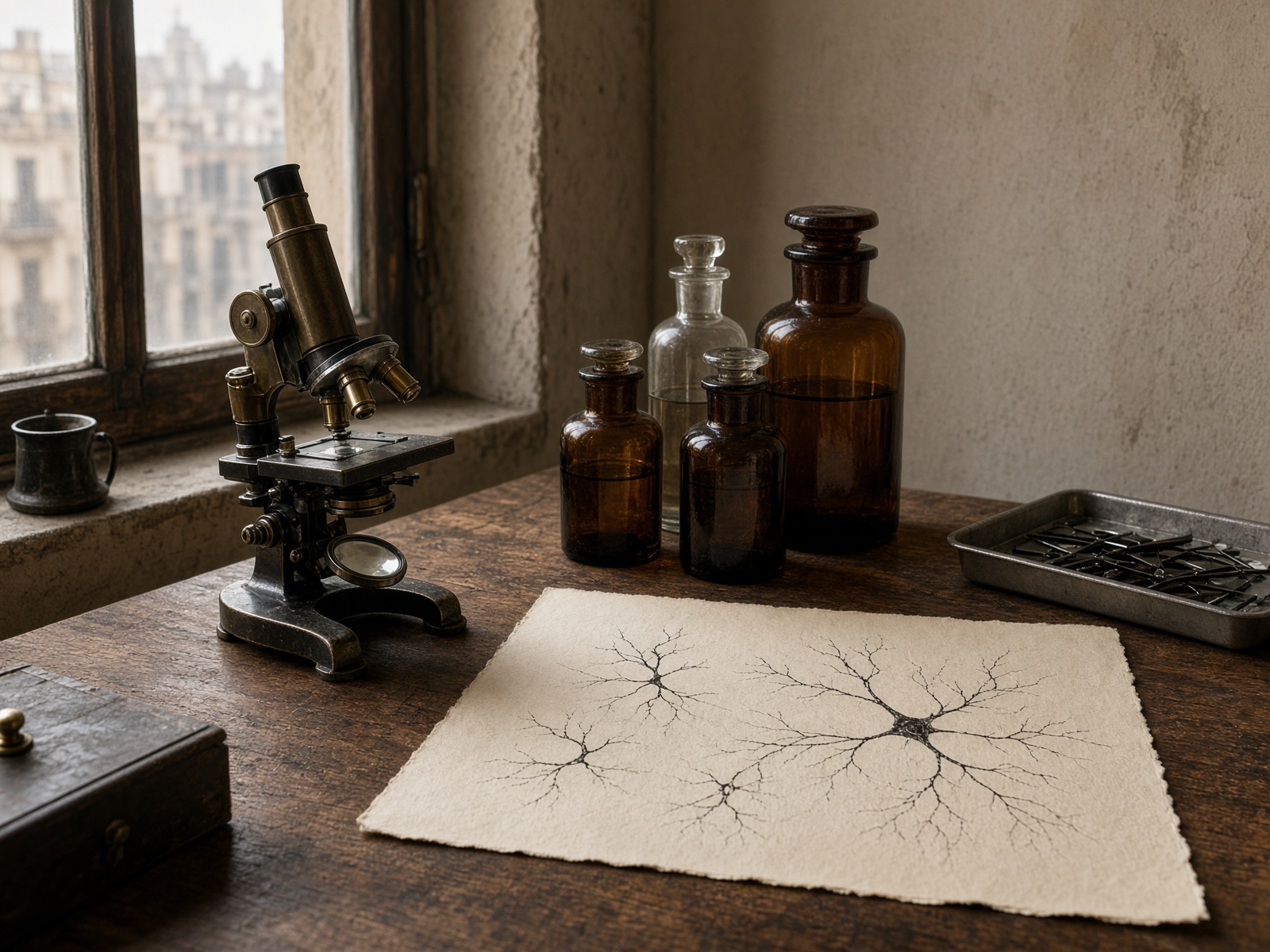
Plate · Generated interpretation
Follow one dark line until it ends. Do not let it become a net.
Listen · Eve
0:00 / —:—
May 1888, in the first issue of Revista Trimestral de Histología Normal y Patológica, Santiago Ramón y Cajal reports that in the brains of birds, stained by Golgi’s method, nerve cells terminate. They do not melt into a continuous reticulum. The drawing is the argument. Golgi, who invented the stain, will spend decades refusing the conclusion. In 1906 they will share a Nobel Prize and not share a theory.
Cajal 1888, bird cerebellum and the neuron as a cell with endings. Later drawings of spines, of the retina, of the cortex, are a life’s work. Public-domain plates exist; this house’s hero is generated interpretation, not a stolen figure.
What consciousness has to do with this is nothing, at first. It is histology. The later temptation is to say: because the brain is made of separate cells that touch, the mind is a network. Cajal did not owe us that leap. Golgi’s net would have been a different picture of how influence travels. Both men were looking at the same black lace.
The neuron doctrine won on anatomical and later physiological grounds. Synapse as a word arrives after. Plasticity, as Cajal imagined it, is a further claim, not the 1888 observation.
Whether a drawing can be a form of knowing as strict as a measurement is a question the plates still pose, independently of any theory of mind.
Distant echoes

Echo
Late twentieth century · California laboratories
Two reports, one skull
A century later, cutting a tract will show that one skull can hold more than one report. Cajal’s endings made such a cut conceivable as anatomy.
One question remains
Mind & body · How does experience live in matter?
If the unit of the brain is a cell that ends, what exactly is the unit of an experience, and why do we keep hoping they will match?