
Event · Self · c. 2nd–3rd century CE
Empty of Own-Being
A verse treatise refuses to let things, including the mind that knows them, stand on their own. The refusal is an argument, not a mood.
- South India, on the page of the *Mūlamadhyamakakārikā*
- Classical Madhyamaka
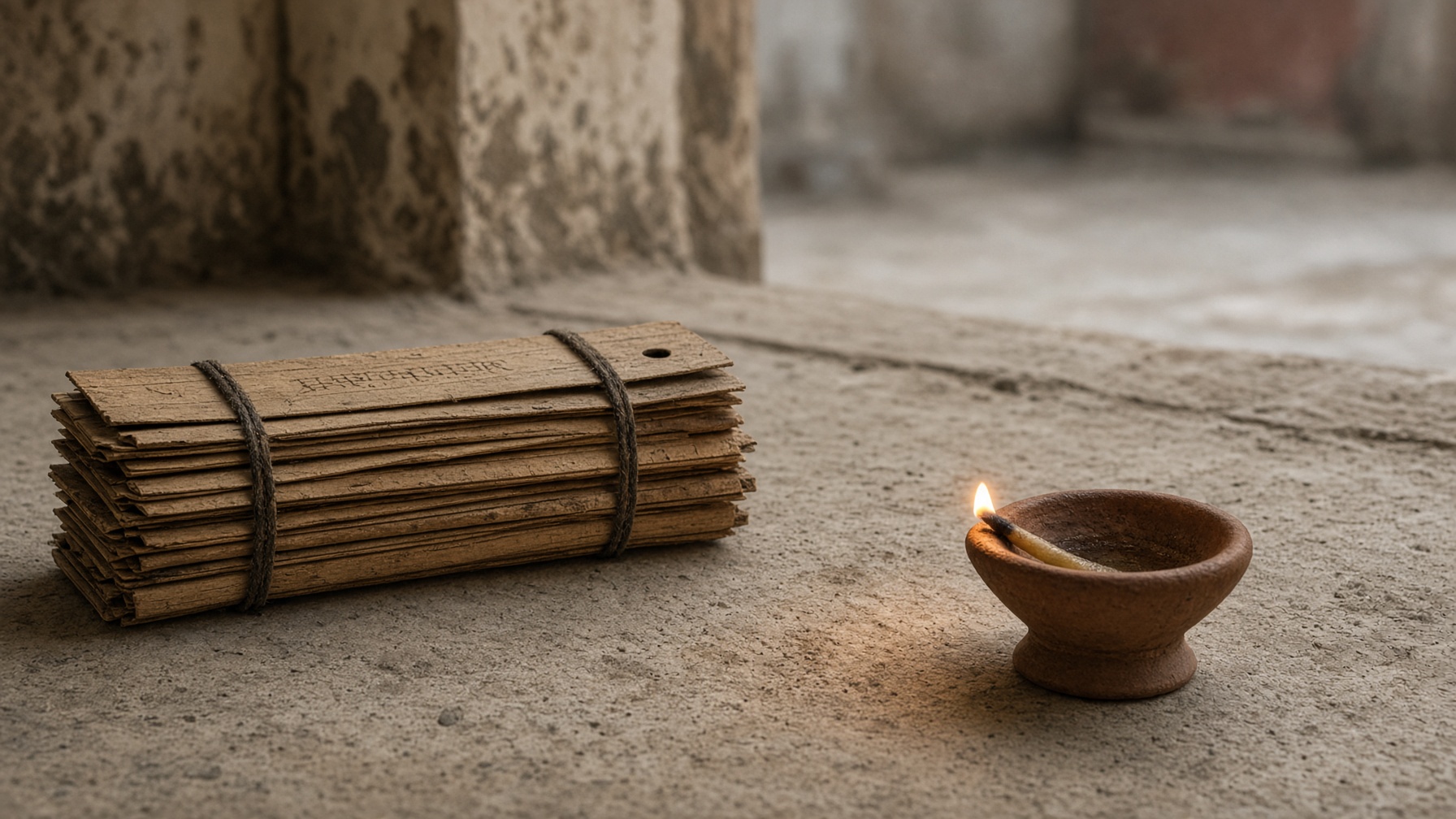
Plate · Generated interpretation
A cart without oxen, or oxen without a cart. What were you calling the thing?
Listen · Eve
0:00 / —:—
The Mūlamadhyamakakārikā (Root Verses on the Middle Way), attributed to Nāgārjuna. Emptiness (śūnyatā) is emptiness of svabhāva, own-being. Dependent arising is not a nothing. The text argues against views, including the view of emptiness as a thing. Vasubandhu’s Yogācāra is another Indian Buddhist grammar, not this one.
Mūlamadhyamakakārikā. Siderits and Katsura, Nāgārjuna’s Middle Way (Wisdom, 2013), is a common English door. MMK 24.18 joins emptiness and dependent arising. The attribution and date remain scholarly arguments.
This is not “everything is illusion” as a shrug. It is a critique of the way things are taken to stand alone. Consciousness, in this grammar, is not spared. Neither is the critic.
Western readers sometimes hear Berkeley or hear nihilism. Both hearings are later. The verses are Buddhist argument in Sanskrit.
If even the knowing is empty of own-being, what, if anything, is left to do the knowing?
Distant echoes
Echo
Gupta-period India · Gandhāra, as later tradition seats him
Twenty verses
Vasubandhu’s Viṃśatikā argues appearance. Nāgārjuna argues that even that argument cannot stand alone. Not one school.
One question remains
Self · Who or what is having the experience?
If a mind cannot be found as a thing, and cannot be denied as a nothing, what kind of knowing is the middle?