
Event · Knowledge · 4th–5th century CE
Twenty Verses, Not a Simulation
A monk answers the charge that if there are only presentations, nothing could bump into anything else.
- Gandhāra, as later tradition seats him
- Gupta-period India
- Gandhāra, approximate
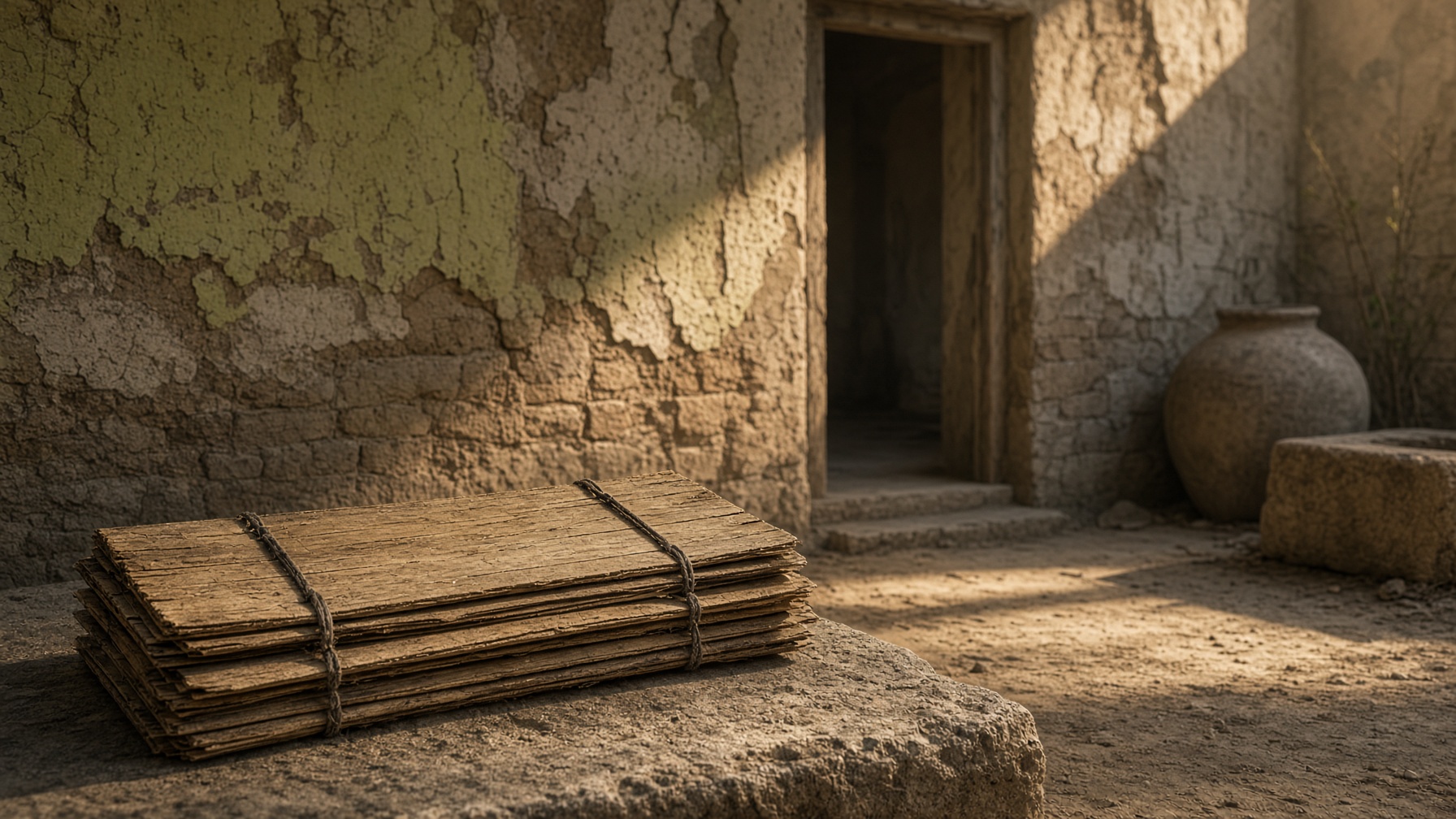
Plate · Generated interpretation
The doorway is empty. What, in the plate, still refuses to be only a picture?
Listen · Eve
0:00 / —:—
A Buddhist scholar of the Gupta centuries, remembered as Vasubandhu, writes twenty verses and a commentary in his own name. Tradition seats him in Gandhāra, the Peshawar valley, a corridor of monasteries and debate on the northwest edge of the empire, and later at Ayodhyā under royal patronage. The dates are the fourth and fifth centuries. The biographies disagree with one another. What we have is the text.
The work is the Viṃśatikā, the Twenty Verses, with the Viṃśatikāvṛtti, his own gloss. It belongs to Yogācāra, a Mahāyāna school concerned with how experience is presented. Vasubandhu is also the name attached to a great Abhidharma treatise. Whether one man wrote both, or whether later memory fused two scholars, is a live fight. Frauwallner’s two-Vasubandhus proposal is a twentieth-century hypothesis. It is not a fact of the Gupta court. For this sitting the verses are enough.
The first claim is not that the world is fake. It is that the three realms are vijñapti-mātra: presentation-only, cognition-only, depending on the translator. Vijñapti is a making-known. Mātra, merely. An objector is already on the page, because the verses are written as a debate. If there are no outer things standing free of the taking, why do appearances keep to places and hours. Why do several people seem to share a world. Why does stealing in a dream not bind like stealing while awake. Why does action bear fruit.
Vasubandhu answers from inside that debate. Dreams already have place and time: a dreamed city is not everywhere at once. Shared horrors, in the Buddhist cosmology he shares with his opponents, can be shared without a second, solid furniture behind them. The atoms of the rival Abhidharma picture will not assemble into a resistant object; partless bits cannot add up to a surface that light and shade can catch. Other minds are not denied. They are accounted for as streams that influence one another. None of this is a probability argument about computers.
The Viṃśatikā and Viṃśatikāvṛtti. Sanskrit readers meet a re-edited text (Silk and others). English readers often come through Stefan Anacker, Seven Works of Vasubandhu (Motilal Banarsidass, 1984), or through Chinese commentarial lines associated with Xuanzang. Those are not one book. Stanford Encyclopedia, “Vasubandhu.” Biography remains hagiographic and contested.
What the verses do on the page is answer specific objections: restriction to place and time, intersubjective regularity, causal efficacy, the incoherence of atoms as outer supports. Dreams are admitted as a comparison, then fenced. Karma and constraint have to be kept without smuggling a second world back in.
Later readers hear idealism, phenomenology, or even simulation. Whether Vasubandhu is a metaphysical idealist is itself a scholarly fight (Lusthaus and others refuse the European costume). A 2003 probability argument about ancestor-simulations is not a fourth-century verse on vijñapti. The verses do not settle our fight by being old.
If appearing is not a copy delivered to a spectator, the grammar “presented to what?” may already be the last movement of the duality the verses undo. That is our question, not theirs.
A word
vijñapti-mātra
Sanskrit. Presentation-only, or representation-only. Vijñapti is a making-known. Mātra, merely. Not a medieval word for simulation.
Distant echoes

Counterpoint
Early twenty-first century · A stage in California, then the feed
One thread among many
Bostrom’s trilemma is a probability argument about computers. Vasubandhu’s verses are a debate about whether outer objects are established. They can sit on the same table. They are not the same object.
One question remains
Knowledge · What counts as knowing?
If what appears is presentation, what, if anything, is the appearing presented to, and is that question already the wrong shape?