
Event · Knowledge · 1976
Star of Gladness
A canoe leaves Maui with no compass. The navigator who keeps it located learned the method on another island, in another language.
- Honolua Bay, Maui, then the ocean toward Tahiti
- Late twentieth-century Hawaiʻi
- 21.01°N 156.64°W
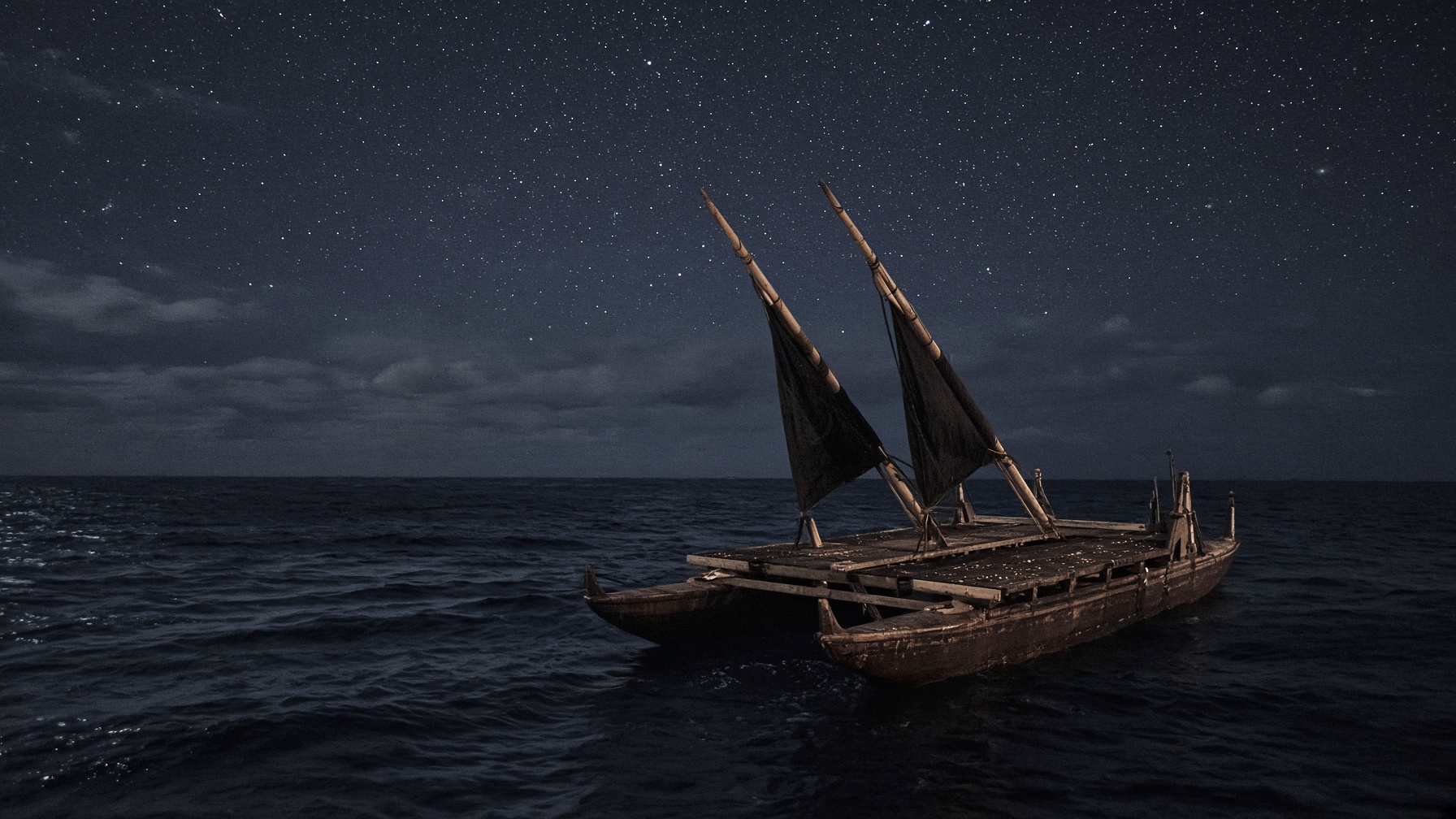
Plate · Generated interpretation
The plate offers water and sky. Where would you put east?
Listen · Eve
0:00 / —:—
1 May 1976, Honolua Bay, on the northwest shore of Maui. The double-hulled canoe Hōkūleʻa leaves for Tahiti. There is no compass on board for the navigator’s work. There is no sextant, no chart of this crossing in his hands. The man who will keep the canoe located is Pius Mau Piailug, from Satawal, a Carolinian atoll in what is now Yap State. The captain is Kawika Kapahulehua. Among the crew are Ben Finney, an anthropologist and a founder of the Polynesian Voyaging Society, and David Lewis, who had already written about Pacific landfinding. The canoe is Hawaiian. The navigator is not.
The canoe had been launched the year before, on 8 March 1975. It is a waʻa kaulua, a double-hulled voyaging canoe, designed as a performance-accurate reconstruction. It is not an archaeological vessel pulled from a sandbank. Herb Kawainui Kāne, with Finney and Tommy Holmes, had founded the Polynesian Voyaging Society in 1973 around two aims that the Society itself has never treated as one. One was a test of history: that the ancestors who settled the islands of the Pacific had sailed on purpose, not drifted. The other was cultural revitalization. Original voyaging canoes had disappeared from Hawaiian waters. The Society built one.
They needed a navigator who still practiced the art without instruments. In the Society’s later account of that first voyage: there was no navigator from Hawaiian culture left. Colonization, mission schooling, steam, and the long interruption of deep-sea canoe travel had broken the Hawaiian line of teaching. That is not the same as saying the knowledge was a mist that evaporated. It is to say a living teacher of that Hawaiian practice was not available in 1976. The Society looked beyond Polynesia. Mau Piailug agreed to come.
Polynesian Voyaging Society, History: “On that first voyage, we were facing cultural extinction. There was no navigator from our culture left.” And: “Mau was the only traditional navigator who was willing and able to reach beyond his culture to ours.” PVS names the outward route Kealaikahiki. Dates: departure 1 May 1976, Honolua Bay; first land Mataiva, Tuamotus, 1 June; Papeʻete Harbor, Tahiti, 4 June. Thirty-four days. Finney published Hokuleʻa: The Way to Tahiti in 1979.
Mau was born in 1932 on Satawal. He was a palu, a initiated navigator, trained from childhood in a Carolinian tradition that still moved between islands without instruments. Satawal is not Hawaiʻi. Puluwat, where Thomas Gladwin later described a related practice, is another Carolinian atoll, not Mau’s home. The canoe is Hawaiian. Mau is Carolinian. Those are not the same tradition, and the voyage does not fuse them. He had not sailed this stretch of water as a home sea.
Without him, our voyaging would never have taken place.
What he is doing, as PVS describes it, is wayfinding: reading stars, winds, waves, clouds, and the living ocean to keep a course and to know when land is near. Stars give direction when the sky is clear. Swell gives it when the sky is not. Birds, cloud piles, a change in the water’s color, the way a wave bends around an island still below the horizon: these are not a romantic list. They are a field of cues that has to be held together long enough for a heading to remain a heading. Helmspeople steer. The navigator says where. How Mau spoke those directions on this crossing, watch by watch, is not a document we have. The public fact is the landfall.
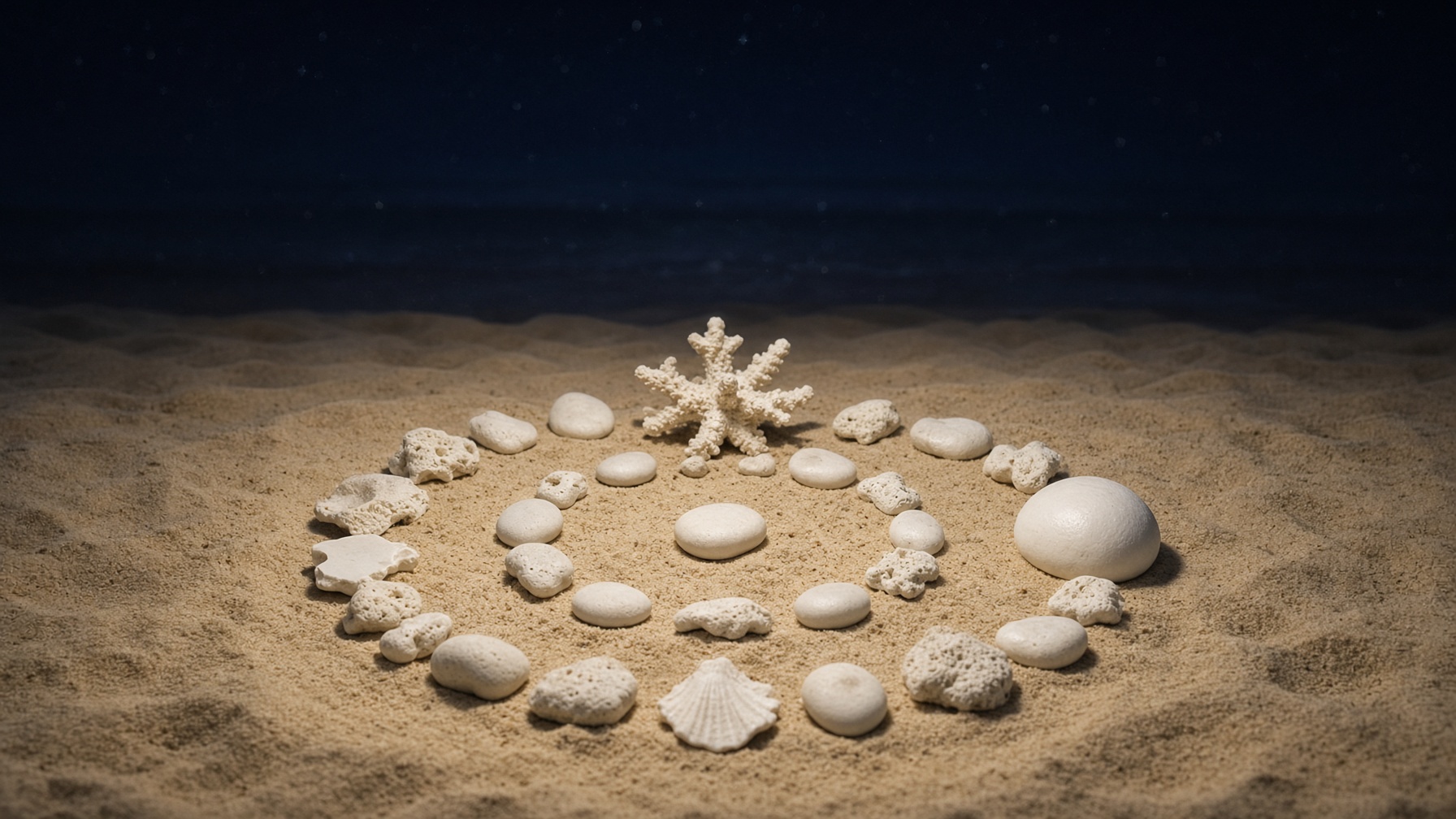
Thomas Gladwin, in East Is a Big Bird (1970), describes navigation on Puluwat. In that account, a system called etak treats the canoe as stationary while a reference island moves back under the steering stars. David Lewis, in We, the Navigators (1972), records the same family of methods, and later sailed on this 1976 crew. The system belongs to Carolinian teaching. It is not a quotation from Mau’s watches on Hōkūleʻa, and it is not a Hawaiian star compass. Using etak of an undocumented hour on this voyage would be a guess.
Hōkūleʻa is the Hawaiian name for Arcturus, often given in English as Star of Gladness or Star of Joy. That naming belongs to Hawaiian sky knowledge. It is not Carolinian. Mau did not become Hawaiian by standing on a Hawaiian deck.
On 1 June they sight Mataiva, in the Tuamotus. Three days later they enter Papeʻete. An estimated seventeen thousand people meet the canoe, more than half the island, by the Society’s count. Herb Kāne said everybody there felt a sense of the canoe belonging to them. Tahiti had genealogies of ancestral canoes and navigators. What it did not have, PVS writes, was a voyaging canoe. The crowd is not a tourist number. It is a recognition that a form of travel thought finished had arrived, crewed, and found the pass.
Arrival is evidence of a successful crossing. It is not a transcript of how the knowing was done hour by hour. The return to Hawaiʻi was navigated with Western instruments. Mau left after Tahiti. Contemporary and later accounts record conflict among the crew. That conflict is not a legend. It is enough to say the success of the outward passage did not make the rest of the year inevitable.
What continued is the teaching. In 1979 Mau returned to train Nainoa Thompson. Nainoa had already begun work at the Bishop Museum planetarium with the astronomer Will Kyselka. The Hawaiian star compass he later used, with thirty-two houses, is his construction, made after study with Mau, not a recovered Hawaiian artifact pulled intact from 1778. In 1980 Nainoa navigated a crossing to Tahiti. That is a subsequent chapter. It is why the landfall of 1976 is not the end of the story.
Edwin Hutchins, in Cognition in the Wild (1995), compares modern Western navigation with Micronesian practice and finds the differences at the level of how the problem is represented and how it is carried out. His claim is that some knowing is not a picture inside one skull. It is a practice distributed across body, canoe, sky, and teaching. That is Hutchins’s frame, written two decades later. It is not Mau’s testimony, and it is not why the canoe left Honolua Bay.
Whether a landfall proves a theory of mind is a separate matter from whether a landfall happened.
A word
etak
A Carolinian term, as Gladwin records it on Puluwat, for a segment of a crossing measured by a reference island moving under the stars. The canoe, in that description, is held still. English has no tidy equivalent. The word is not a Hawaiian lemma, and using it of the 1976 watches would be a guess.
Distant echoes

Echo
Gilded Age America · Cambridge, Massachusetts
The stream of thought
James called attention a stretch toward. Out here the stretch has to last for weeks, and the object is a direction that does not stay put in the water.
Another language
Weimar science · On the page, from Hamburg and the Baltic
The tick’s world
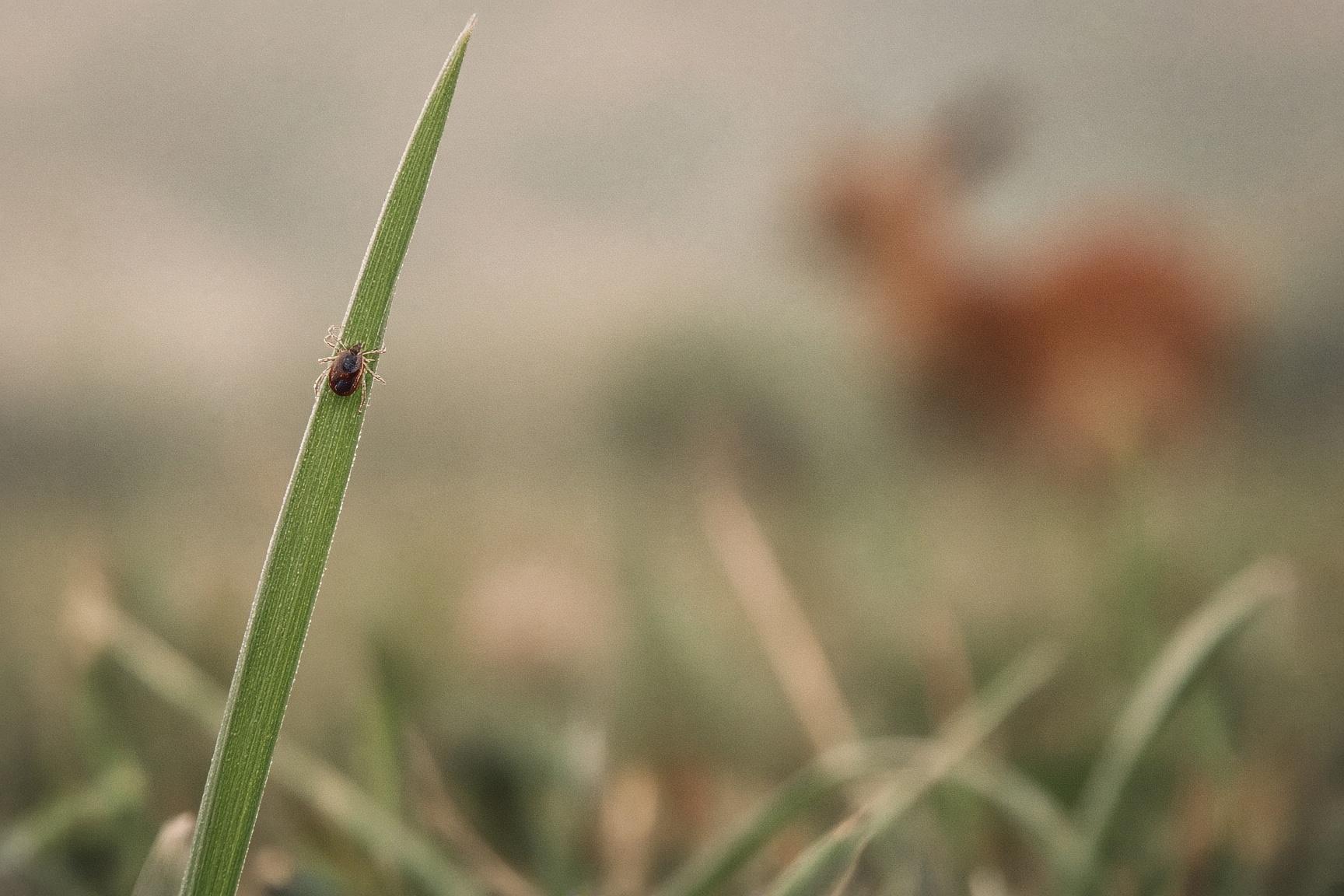
The tick lives by three signals. A navigator lives by many. Both are worlds with a grammar. Neither is the sitting-room taken as default.

Counterpoint
Late antiquity · Hippo Regius
The palaces of memory
Augustine walks rooms inside the skull. A star compass is held in practice, on deck, under a sky that can cloud. Two memories, two addresses.
One question remains
Knowledge · What counts as knowing?
If a person can know where they are without a chart, is the knowing in the head, in the canoe, or in a practice that will not sit still for the question?