
Event · Knowledge · c. 699–704
The Lion Was Gold
A monk at court uses a golden lion to show an empress that each part of the world is the whole, without the parts vanishing.
- Chang'an, in the palace telling
- Tang China
- 34.27°N 108.95°E
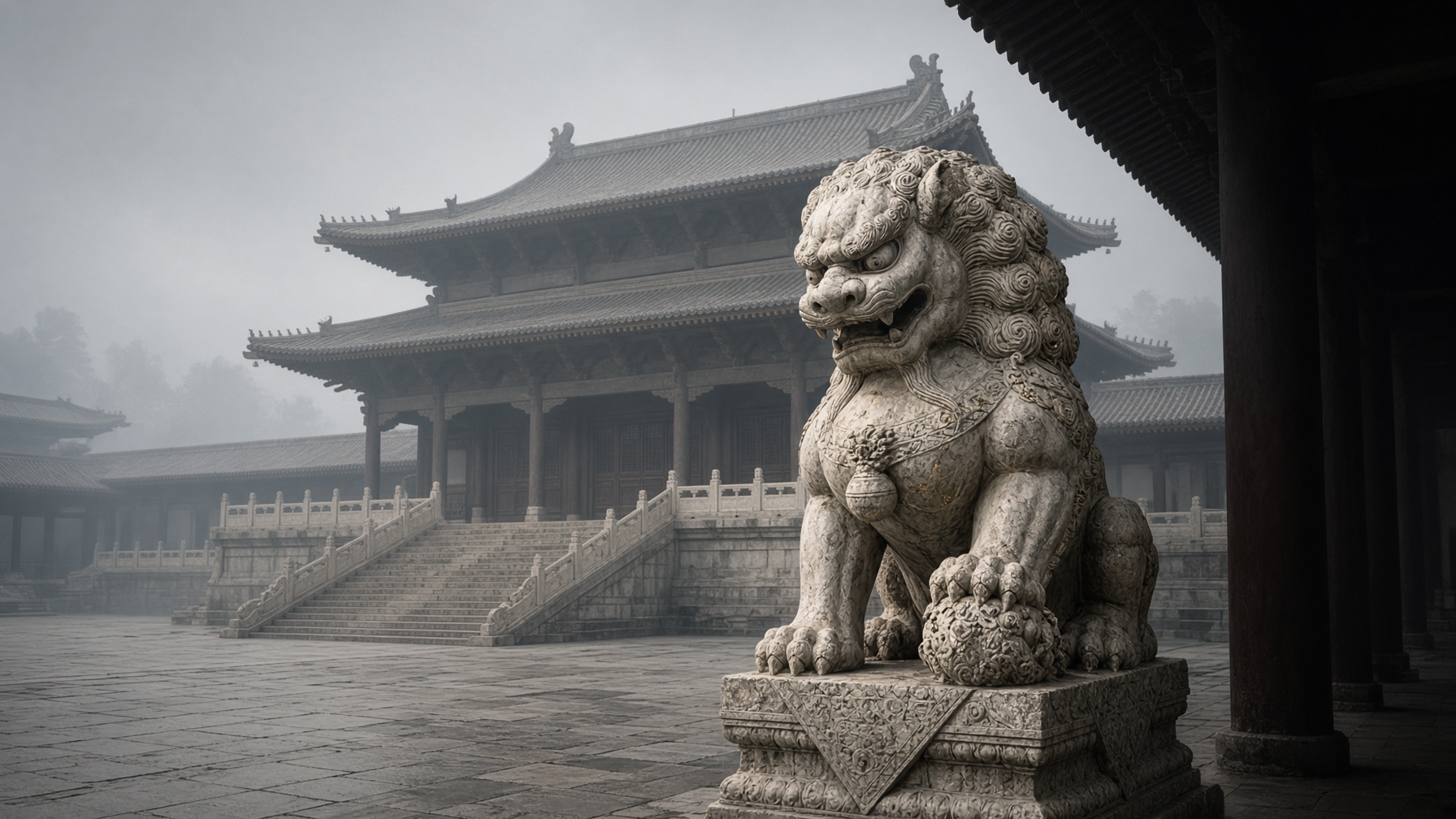
Plate · Generated interpretation
One gold, many parts. Which do you treat as the thing?
Listen · Eve
0:00 / —:—
Chang’an, around 700. Tradition says Fazang (643–712), a Sogdian-Chinese monk and the great systematizer of Huayan teaching, explained the Avataṃsaka to Empress Wu Zetian with a golden lion at the palace: the lion’s parts are many; the gold is one; each hair, in the teaching, can hold the lion. He wrote a short essay, Jin shizi zhang (Treatise on the Golden Lion). Dates of the palace sitting vary in the sources. Treat the demonstration as tradition’s scene, not as a photograph of a gate.
The gold is emptiness, not “nothing exists.” The lion is form, the play of dharmas. Interpenetration, in Huayan, is a Buddhist claim about how things arise together, not a claim that your network is the cosmos. Fazang was a translator and a court teacher. The lion is pedagogy for a ruler. It is also, in the essay, a compressed metaphysics.
Jin shizi zhang, Taishō 1881. Internet Encyclopedia of Philosophy, “Fazang.” Analogy to holography is a later toy. Mark it as analogy. The palace lion is not a physics demonstration.
Vasubandhu argues presentation-only in another Buddhist register. Fazang shows a lion of gold. Two tools, not one slogan. Empress Wu is not a student of information theory.
Gold as emptiness, lion as form: a teaching pair. Whether a court metaphor can be a way of knowing, or only a way of teaching, is the leftover. The leftover is honorable. Not every teaching is a finding.
Whether a court metaphor can be a way of knowing, or only a way of teaching, is the leftover.
Distant echoes

Echo
Gupta-period India · Gandhāra, as later tradition seats him
Twenty verses, not a simulation
Vasubandhu argues presentation-only. Fazang shows a lion of gold. Two Buddhist tools, not one slogan.

Echo
Classical Greece · Athens
The fire and the wall
Plato’s cave is a pedagogy of shadows. Fazang’s lion is a pedagogy of gold. Two courts of teaching, two metals.
One question remains
Knowledge · What counts as knowing?
If each part holds the whole, what, if anything, is still a part?