
Event · Mind & body · c. 50s BCE
The Soul That Can Be Cut
A Roman poem says mind and soul are matter, fine but mortal, and die with the body they are woven through.
- Italy, on the page of a poem
- Late Roman Republic
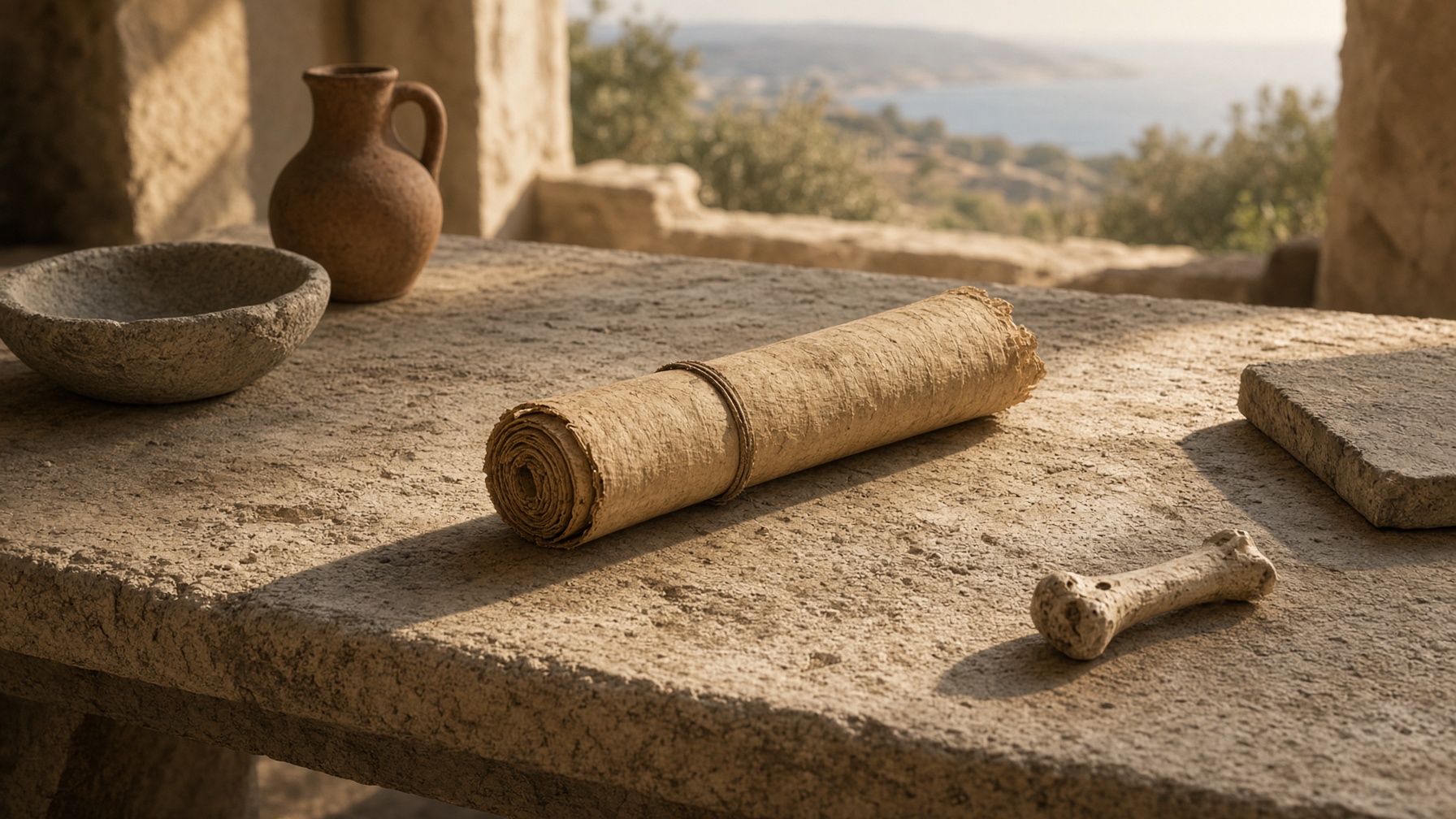
Plate · Generated interpretation
A closed roll. What, in you, assumes it will outlast the paper?
Listen · Eve
0:00 / —:—
A Latin poem, first century BCE, tells a reader not to fear an afterlife. Titus Lucretius Carus, De rerum natura (On the Nature of Things), Book 3: mind and spirit, animus and anima, are of the body, woven through it, made of fine first-beginnings, and they scatter when the body that holds them fails. English often says atoms. Lucretius says primordia, seeds, bodies. Epicurus is the named teacher. The poem is the evidence we have of this Roman Epicureanism. It is not modern neuroscience in a toga.
If wine and fever can disorder the mind, the poem says, the mind is of the body. If the spirit can be cut with a limb, it is extended. The arguments are analogical and fierce. They are not an fMRI. The hymn to Venus at the start of the poem, and the plague at the end, are the same physics in two keys: a world of bodies in a void, swerving enough that something new can happen, mortal all the way through.
De rerum natura, Book 3. Perseus holds Latin and older English. The fear of death, for the poem, is a waste, because death extinguishes feeling. Consolation is the argument’s aim. Whether a reader is consoled is not in the Latin.
Anima here is not a Christian soul. Translating it as consciousness is a convenience with a cost. The poem wants to free the living from priests of punishment after death. That is a first-century quarrel. Our laboratories are another. They can sit on the table. They are not one materialism.
Whether mortality of mind is a consolation or a terror is not settled by the first-beginnings. The poem takes a side. That side is not a finding of physics.
Whether mortality of mind is a consolation or a terror is not settled by the atoms.
Distant echoes
Echo
Modern medicine · Operating theaters everywhere
When the lights go out
Anesthesia erases a morning with a molecule. Lucretius erases an afterlife with a first-beginning. Two materialisms, two fears.
Echo
Late 1990s France · Berck-sur-Mer, Hôpital Maritime
A blink for a letter
Bauby’s mind stays while the body will not answer. Lucretius says mind and body fail together. Two tests of where a mind lives.
One question remains
Mind & body · How does experience live in matter?
If the mind is mortal with the body, what, if anything, was it for, while it lasted?