
Portrait · Mind & body · 1997
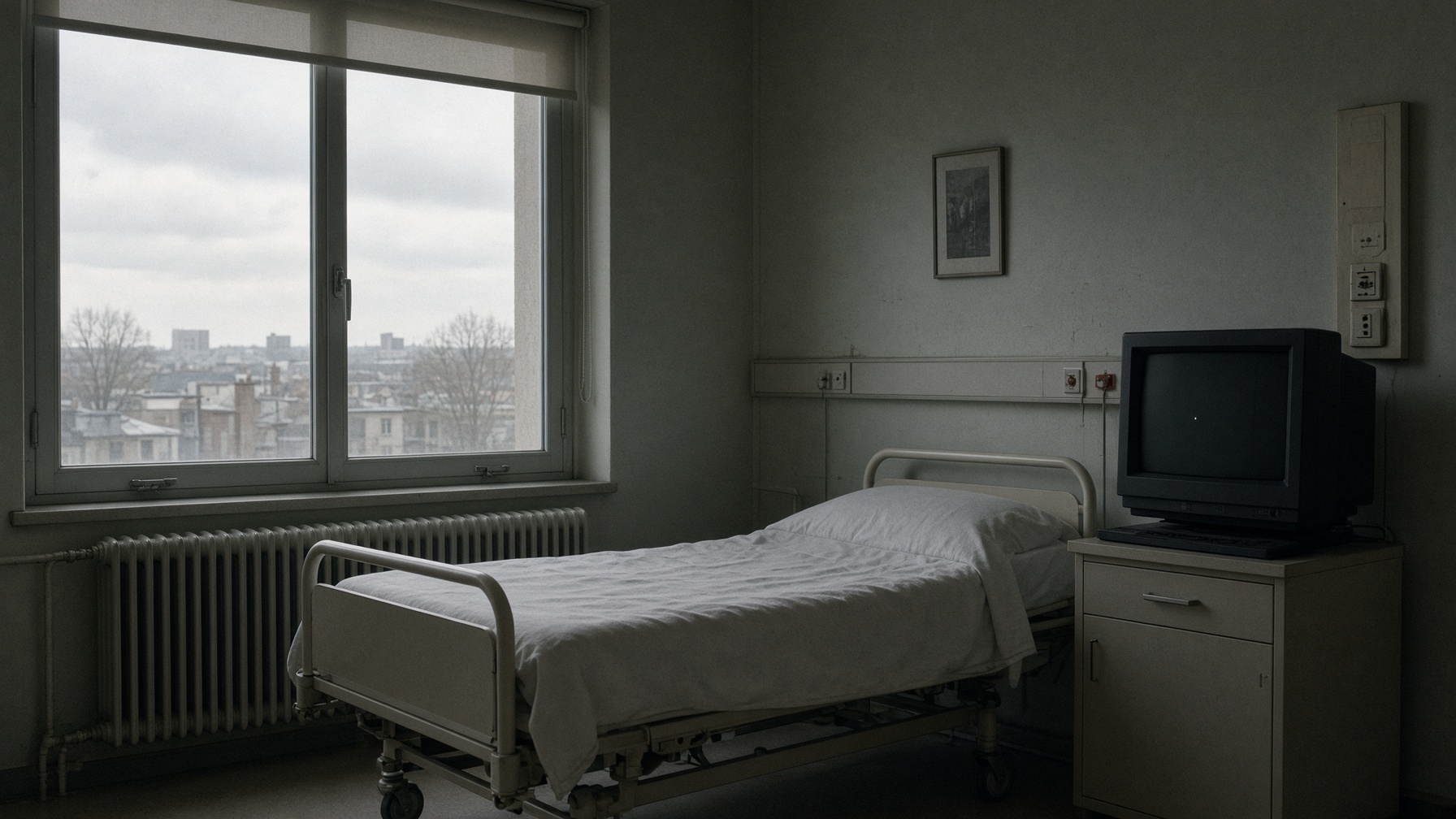
Plate · Generated interpretation
A Blink for a Letter
After a stroke, a man can move only his left eyelid. He dictates a book that way. The mind on the page is not the body the ward can see.
- Berck-sur-Mer, Hôpital Maritime
- Late 1990s France
- 50.41°N 1.56°E
A dark screen. What would one letter cost?
Listen · Eve
0:00 / —:—
Berck-sur-Mer, Hôpital Maritime, after 8 December 1995. Jean-Dominique Bauby, forty-three, editor of Elle, has a brainstem stroke. What remains of movement is the left eyelid. Locked-in is the medical name. His speech therapist, Sandrine Fichou, orders the alphabet by how often French uses the letters. Claude Mendibil, sent by the publisher Robert Laffont, recites. Bauby blinks at the letter he wants. A book is dictated that way, a few hours a day, over weeks. Le Scaphandre et le Papillon is published on 7 March 1997. He dies on 9 March.
The diving bell is the body that will not answer. The butterfly, in his figure, is what still moves. The book is literature, not a case file. It describes the method and the days: a window, a visit, a letter paid for in blinks. Ibn Sīnā imagined a man floating with no body. Bauby had a body that would not answer. The thought experiment and the ward are not the same object.
Le Scaphandre et le Papillon. Paris: Robert Laffont, 1997. The medical name is locked-in syndrome. Interior life in locked-in patients is now a clinical research field. Bauby’s pages are not that field’s data.
Whether a blink can carry a self is not a riddle in this case. It is a fact: the book exists, letter by letter, with a collaborator who did not invent the sentences. What it does to our picture of mind is the leftover. Disability is not a metaphor for philosophy. Courage here is ordinary and costly. It is not a proof.
The book exists. The method is described. A self was dictated. That is not the same as saying a self is only a sequence of letters. It is to say the sequence got through.
Whether a blink can carry a self is not a riddle. It is a fact in this case. What it does to our picture of mind is the leftover.
Distant echoes
Echo
Islamic Golden Age · On the page, from Bukhara to Hamadan to Isfahan
The floating man
Ibn Sīnā suspends the body to find a self. Bauby’s body is present and mostly silent. Two tests.
Echo
Late Roman Republic · Italy, on the page of a poem
The soul that can be cut
Lucretius says mind and body fail together. Bauby’s mind stays while the body will not answer. Two materialisms, two rooms.
One question remains
Mind & body · How does experience live in matter?
If a self can be dictated one letter at a time, where was it while the letter was waited for?