
Portrait · Self · 1976
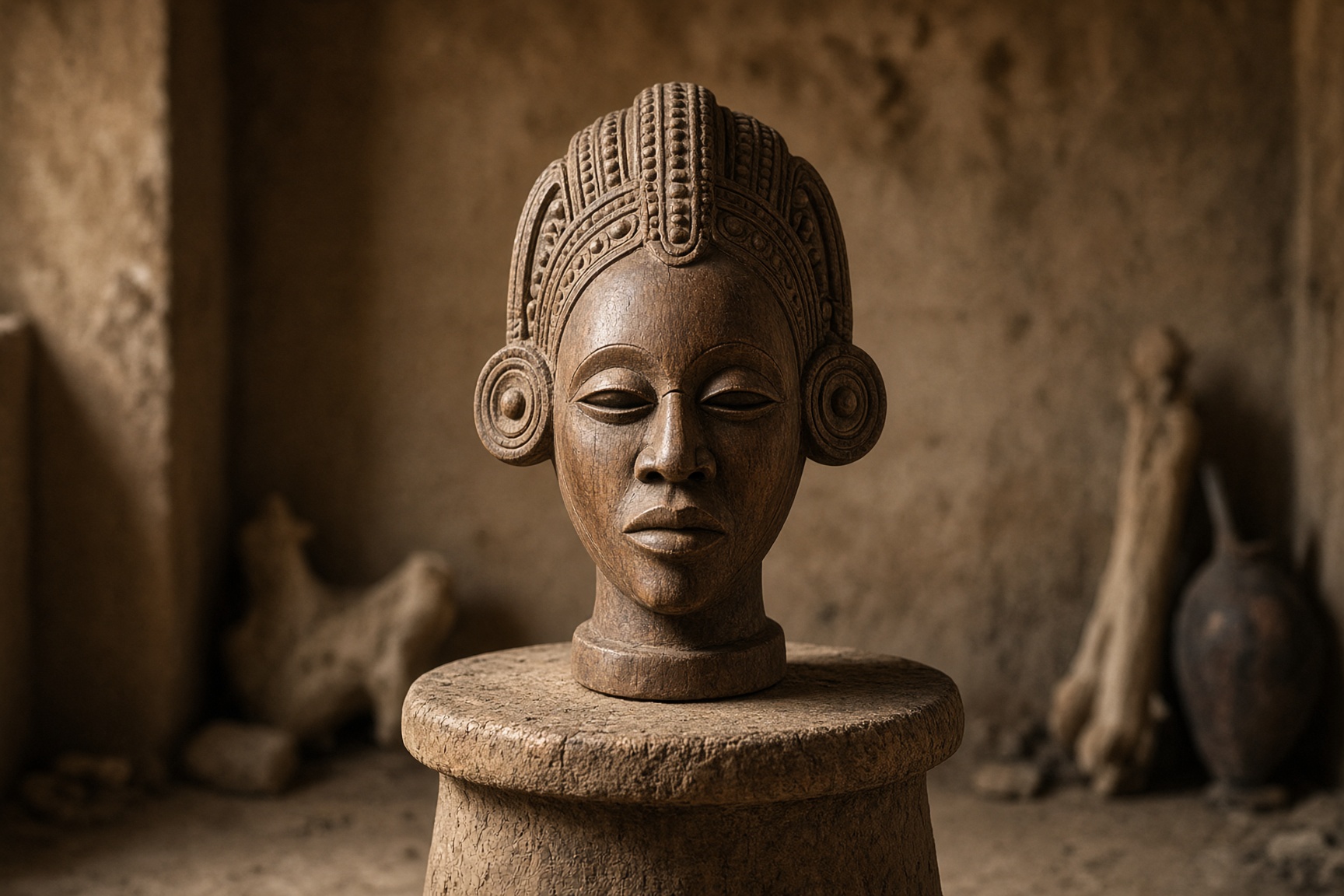
Plate · Generated interpretation
The Inner Head
A Yoruba scholar of Ifá explains ori: the physical head, and the inner head one is said to have chosen, which is not a European soul in disguise.
- Ilé-Ifẹ̀, and on the page
- Twentieth-century scholarship of a living tradition
- 7.47°N 4.56°E
A carved head. Where do you place the inner one?
Listen · Eve
0:00 / —:—
Wande Abimbola, a Yoruba scholar of Ifá, later Awise Awo Agbaye, the spokesperson of Ifá in the world, sets ori on the page so that English cannot swallow it. Ori is head: the head one can touch. Ori-inu is inner head: bound up, in the Ifá corpus he exposits, with the destiny one is said to have chosen, and with character one still has to live. This is not “Africans believe” as a proverb card. It is a named scholar, a named corpus, a living practice. A carved wooden head can stand for ori. It is not ori.
In the tradition Abimbola opens, a person, before birth, chooses an inner head, as at the workshop of a heavenly potter. That choice is not a European soul in disguise, and not a slogan about free will. What one chose has to be lived. Character (ìwà) still matters. How fixed the choice is, and how far ritual and good character can repair a difficult ori, is a live argument among Yoruba philosophers. Segun Gbadegesin and others keep the argument open. Abimbola is a door, not the whole Yoruba world.
Abimbola, Ifá: An Exposition of Ifá Literary Corpus (Oxford, 1976), and related essays. Later debates on how fixed ori is belong on the table, not as a correction that erases him.
Kwasi Wiredu refused to let English mind assemble an Akan person. Ori is not okra. It is not soul. Using those English hosts without remainder is a flattening. The languages of West Africa are not one language. A museum light on a carved head is not the practice in which ori is fed, praised, and consulted.
A carved head can be a symbol of ori. It is not ori. Museum light is not the practice. Consciousness, as an English research word, is not a tidy host for ori-inu.
Whether a person can remake a chosen inner head is a live argument, not a slogan about free will.
A word
ori-inu
Yoruba. Inner head. Not a tidy English soul or personality.
Distant echoes

Echo
Late twentieth-century Ghana · Legon, and on the page
What English calls mind
Wiredu and Abimbola both refuse a borrowed ontology. The languages are not one West Africa.

Echo
Interwar Europe · Germany and later Jerusalem, on the page
I and You
Buber’s You is a relation in German. Ori is a head in Yoruba. Two grammars of the person. Neither is the other’s translation.
One question remains
Self · Who or what is having the experience?
If the inner head is chosen and also lived, which knowing is the person’s, and which is the world’s?