
Science · Perception · 1953
The Eyes, Still Sleeping
A graduate student in Chicago watches a sleeping child’s eyes jerk beneath closed lids, and sleep stops being a single blank.
- University of Chicago
- Mid-twentieth-century physiology
- 41.79°N 87.60°W
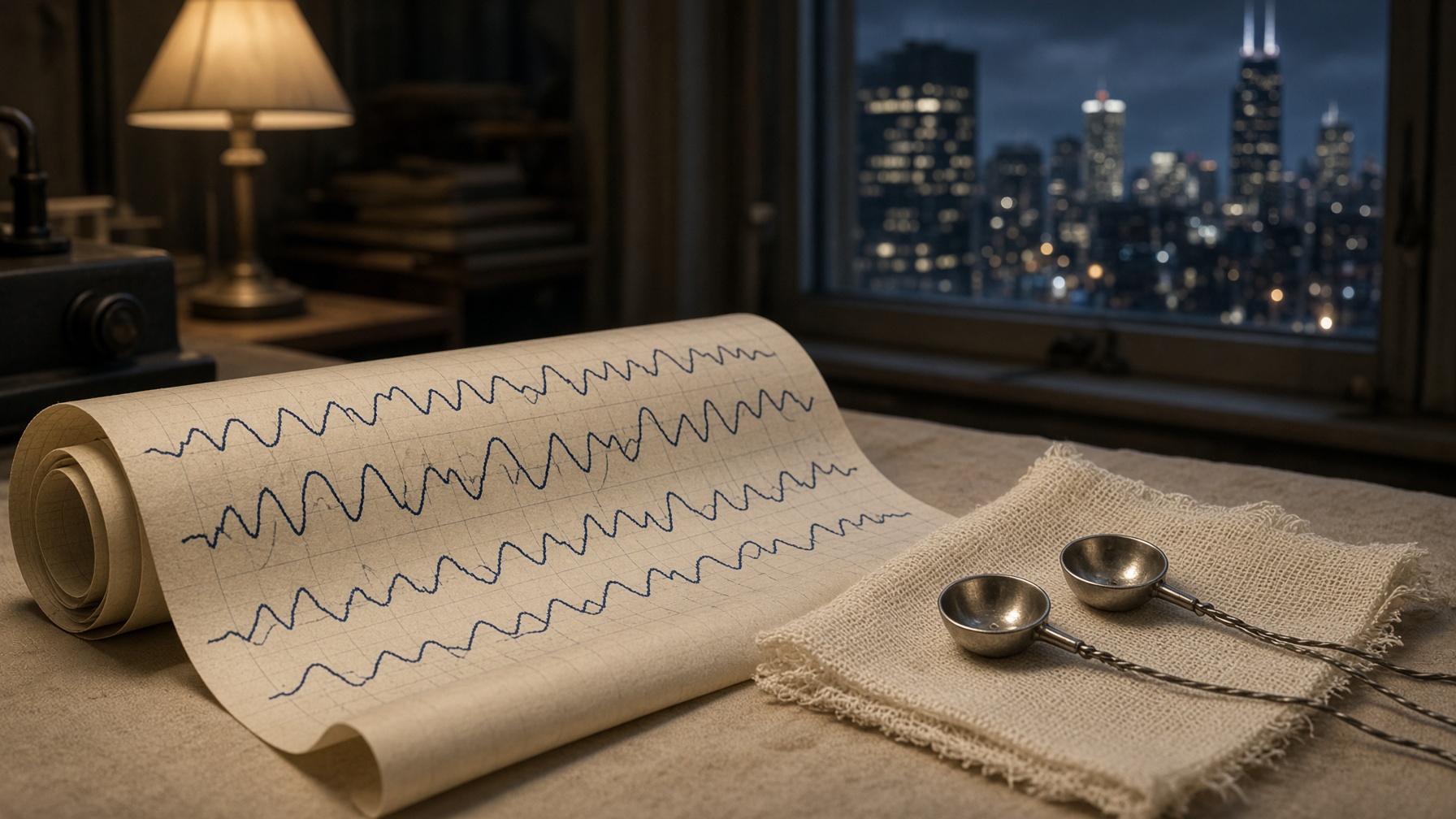
Plate · Generated interpretation
Closed lids. What would you need in order to say a dream is happening now?
Listen · Eve
0:00 / —:—
University of Chicago, Abbott Hall, a December evening in 1951. Eugene Aserinsky, a graduate student in Nathaniel Kleitman’s sleep laboratory, tapes electrodes near the eyes of his eight-year-old son, Armond, who has agreed to sleep on an army cot. He asks the boy to look left, right, up, down, so the pens of the recorder have a waking baseline. Later in the night the pens that track the eyes swing again as if Armond were looking around. Aserinsky goes in. The child is asleep.
Kleitman had first set him to watching infants’ lids by eye. That sitting taught little. The machine, an Offner Dynograph, made a paper record of movement the sitting could miss. Rapid, jerky, binocularly symmetrical swings, in periods that returned through the night, were not the slow rolls of falling asleep. They looked like looking. The sleeper, woken from those periods, often had a dream to tell. Woken from quieter stretches, often did not.
Aserinsky and Kleitman, “Regularly Occurring Periods of Eye Motility and Concomitant Phenomena During Sleep,” Science 118 (4 September 1953): 273–274. The paper is an observation of motility, correlated with report. Dreaming is not identical with the eye movement. Later work finds mentation in other stages of sleep. The 1953 article does not yet use the later shorthand REM as a synonym for a dream self.
Sleep, in the textbooks Aserinsky inherited, had been a blank, a lowering of the lights. Kleitman’s laboratory had already been arguing that sleep had a physiology. The eye periods made a night into rooms that could be timed. William Dement, soon after, would spend a career in those rooms. Aserinsky did not stay. The paper is short. The child on the cot is not named in it. The naming belongs to later accounts, including Aserinsky’s own.
The finding is a regularly occurring period of rapid eye movement during sleep, with a raised chance of a dream report on waking. It is not a transcript of the dream. It is not proof that the eyes are watching a scene. Correlation with report is not identity with a self.
Zhuangzi’s butterfly cannot be deposed. Aserinsky can wake a sleeper and ask. The asking is already a waking document. That does not make the eye movement nothing. It makes a method: a night can be sampled. What is sampled is a report, and a motion of the lids. The rest remains with the sleeper.
A physiological marker of a night is not a proof of which side is home. It is a way to time a question. Later sleep science will refine stages, deny that only REM dreams, and still use the 1953 observation as a door. The door is motility. What, if anything, is being seen, and by whom, is not in the ink.
If the eyes move as if seeing, what, if anything, is being seen, and by whom?
Distant echoes

Echo
Warring States China · The state of Song, traditionally
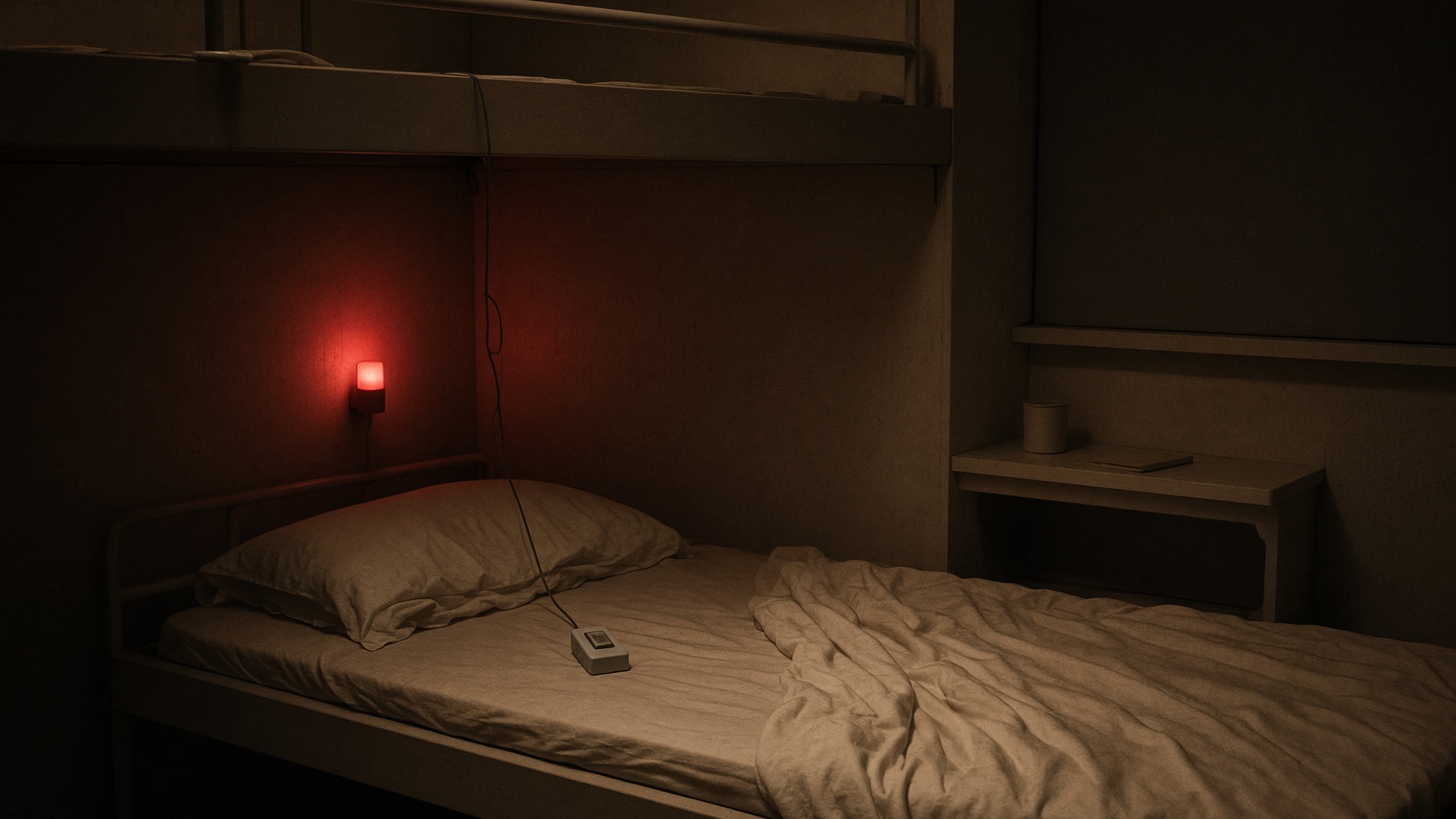
Once Zhuang Zhou dreamed
A butterfly that cannot be interviewed. REM is an interview with the lids still shut.
Echo
Late twentieth-century sleep research · Stanford University
Asleep, and knowing it
Lucid dreaming is a later claim that the sleeper can know the room from inside. Aserinsky’s method knows it from a pen and a question after waking. Two clocks.
One question remains
Perception · What does sensing give us?
If a night can be cut into rooms by a twitching lid, is the dreamer in every room, or only in the one that can later be told?