
Science · Self · 1983
The Half-Second Before
A clock, a flex of the wrist, a scalp potential that seems to rise before the reported wish to move. The finding is famous. It is also contested.
- University of California, San Francisco
- Late twentieth-century neuroscience
- 37.76°N 122.46°W
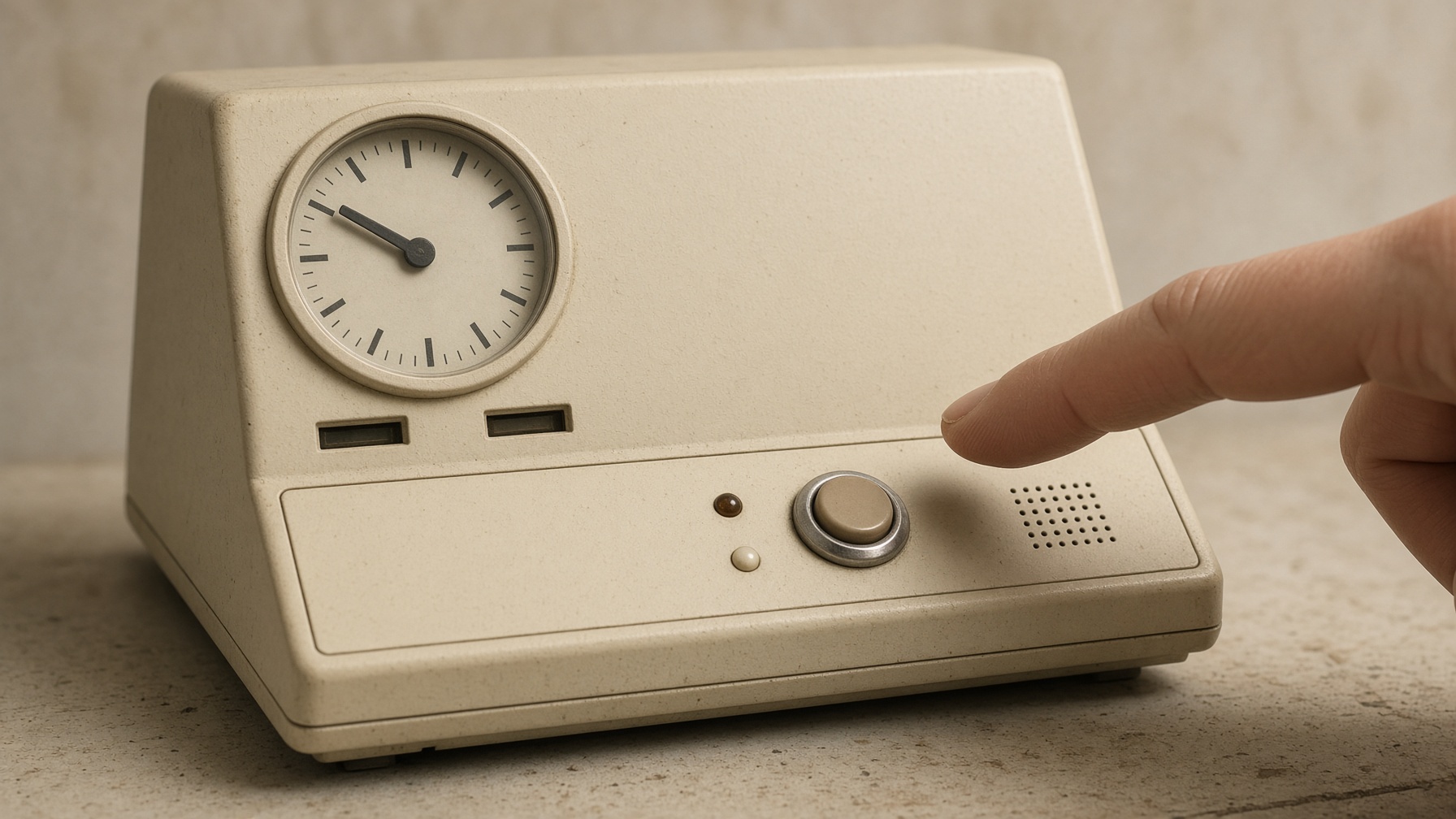
Plate · Generated interpretation
The hand has not yet moved. What, if anything, feels like the start?
Listen · Eve
0:00 / —:—
Benjamin Libet, “Time of Conscious Intention to Act in Relation to Onset of Cerebral Activity (Readiness-Potential),” Brain 106 (1983). Subjects watch a clock, flick a wrist at a time of their choosing, and later report the clock position of the urge. The readiness potential, on average, begins hundreds of milliseconds earlier. Libet kept a veto: consciousness might still stop the act.
Libet et al., Brain 106 (1983): 623–642. Kornhuber and Deecke had described the Bereitschaftspotential earlier. Schurger, Sitt, and Dehaene (2012) argue that the rise can be a leaky accumulator, not a decision unfolding in secret.
Popular retellings say science showed free will is an illusion. That is a leap. The paper is a timing study of a arbitrary flick, averaged. It is not a metaphysics of moral life. The house marks the leap as a leap.
Even if the potential precedes the report, the report is still a fact of experience. Precedence is not the same as unreality.
Whether “will” names a moment, a veto, or a life is not settled by a clock.
Distant echoes

Echo
Early modern Europe · A stove-heated room in Germany, later on the page from the Netherlands
I think, in a stove-heated room
Descartes begins from a thinking that cannot be doubted. Libet begins from a flick that might have already begun.
One question remains
Self · Who or what is having the experience?
If a brain event can be measured before a wish is named, is the wish late news, or is the measurement early gossip about a life that is not a flick?