
Science · Knowledge · 1981
Asleep, and Knowing It
A sleeper in a Stanford laboratory moves his eyes in an agreed pattern. The movement is the proof that he knows he is dreaming.
- Stanford University
- Late twentieth-century sleep research
- 37.43°N 122.17°W

Plate · Generated interpretation
You are asleep and you know it. Which knowing is the proof?
Listen · Eve
0:00 / —:—
Stephen LaBerge. Lucid dreaming: knowing, while dreaming, that one is dreaming. Eye-movement signals from REM sleep to the lab. Lucid Dreaming (1985) is a later book. The 1981 papers with Lynn Nagel, William Dement, and others put a private claim on a public trace.
LaBerge, Nagel, Dement, and Zarcone, “Lucid Dreaming Verified by Volitional Communication during REM Sleep,” Perceptual and Motor Skills 52 (1981). Earlier phenomenological reports exist (van Eeden, 1913). The laboratory is a verification of communication, not the invention of the experience.
Aserinsky showed a night of rooms. LaBerge shows a room in which a dreamer can send a letter. Zhuangzi cannot be asked to signal. That is the difference between a dream as parable and a dream as protocol.
Knowing that one is dreaming is a form of metacognition. It is not a proof that waking is the only real, or that lucid control is the aim of a night.
Which awareness is the proof: the dream’s, the signal’s, or the later paper’s?
Distant echoes
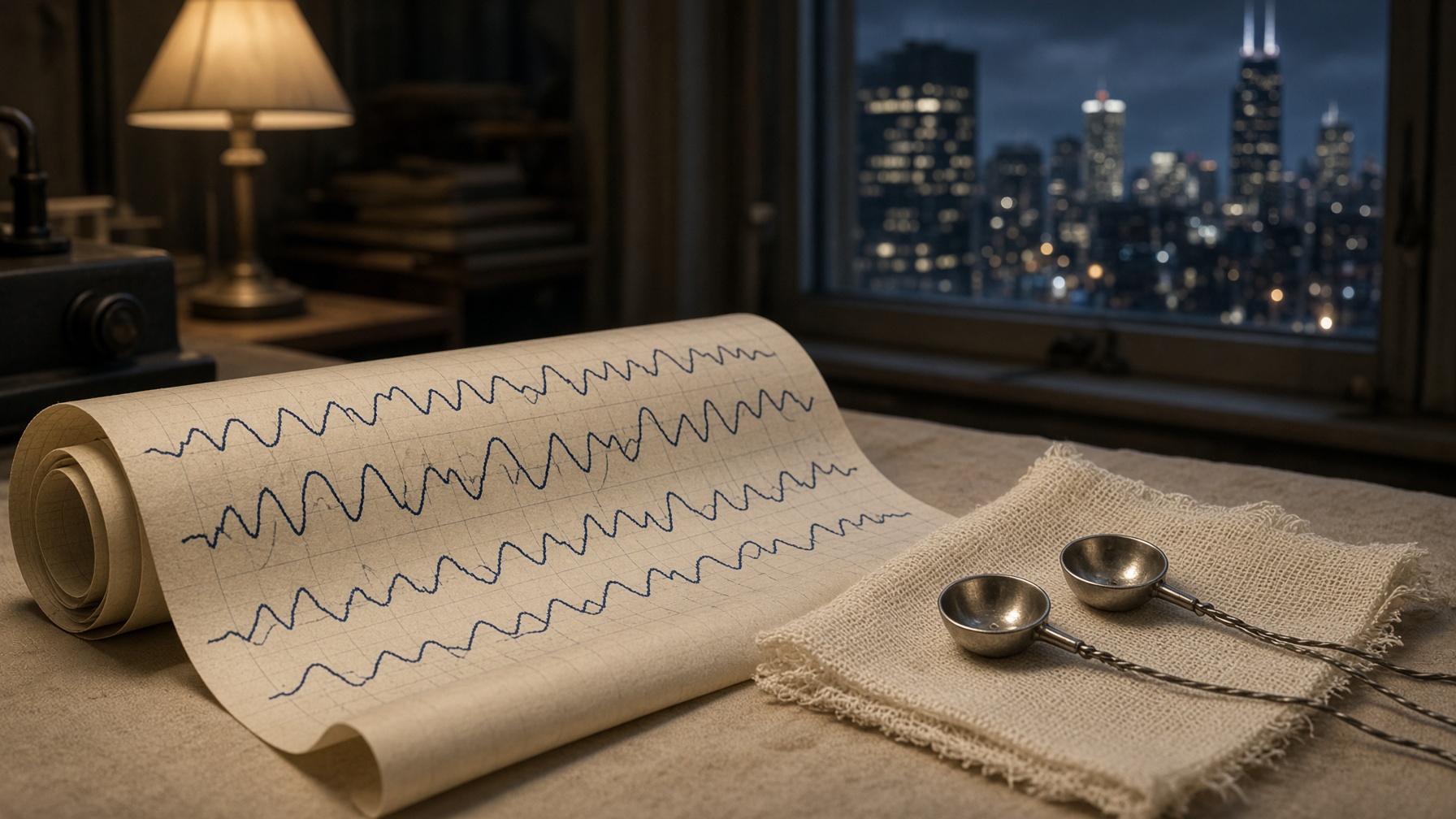
Echo
Mid-twentieth-century physiology · University of Chicago
The eyes, still sleeping
Aserinsky timed the rooms. LaBerge posted a letter from one of them.
One question remains
Knowledge · What counts as knowing?
If you can know you are dreaming, what, then, is the difference between a world that can be signalled and a world that can be trusted?