
Science · Other minds · 2006
Imagine Playing Tennis
A young woman diagnosed as vegetative is asked, inside a scanner, to imagine a game. The brain answers as a healthy volunteer’s brain answers.
- Cambridge
- Early twenty-first-century neuroimaging
- 52.21°N 0.09°E
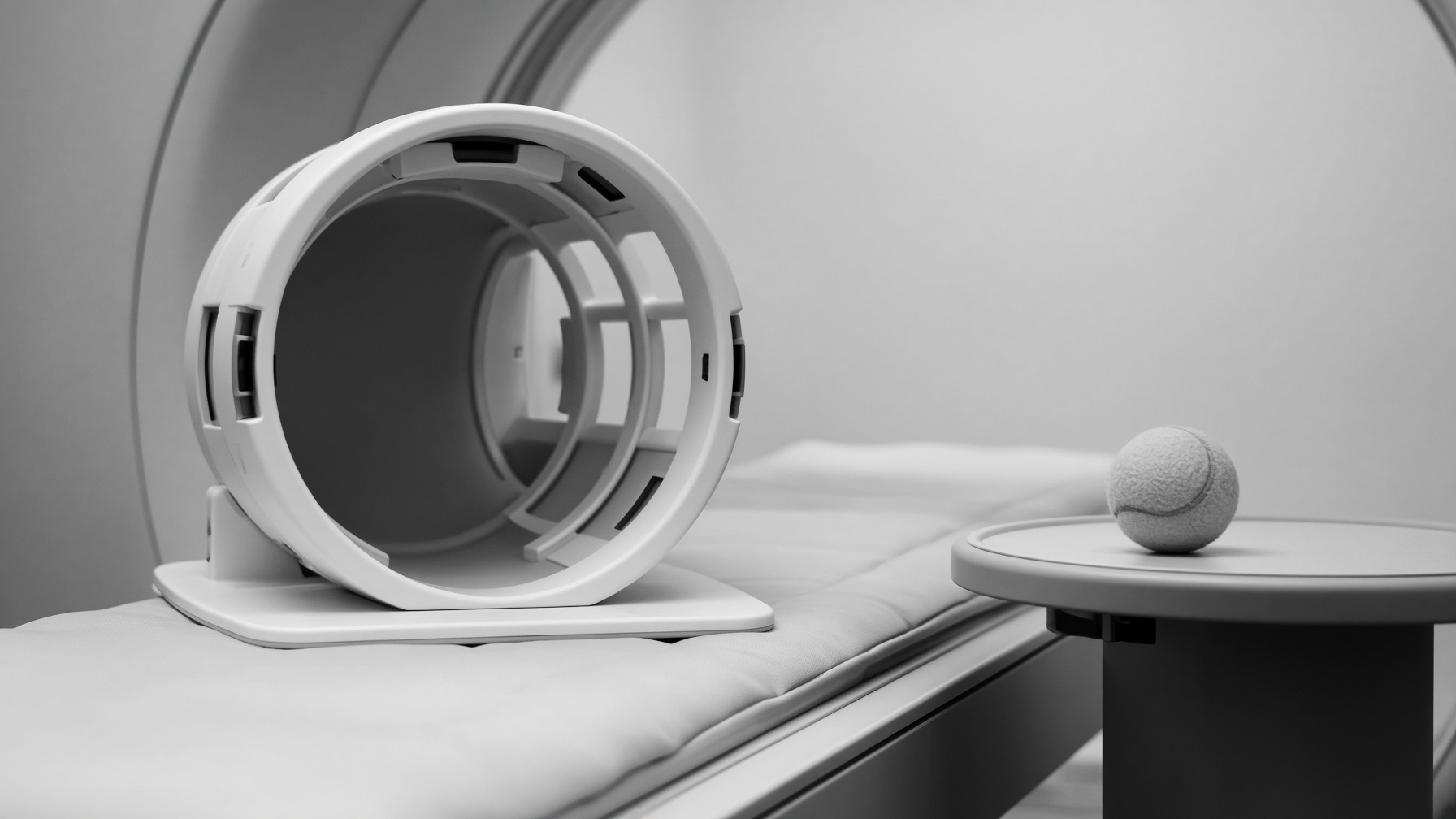
Plate · Generated interpretation
A scanner, no face. What would count, for you, as an answer from inside?
Listen · Eve
0:00 / —:—
Adrian M. Owen and colleagues, “Detecting Awareness in the Vegetative State,” Science 313 (8 September 2006). A 23-year-old woman, five months after trauma, clinically vegetative. Asked to imagine playing tennis, or walking through her home, her fMRI pattern matches controls. The paper does not interview her. It shows a willful modulation of blood flow.
Owen et al., Science 313 (2006): 1402. DOI 10.1126/science.1130197. Later work names cognitive motor dissociation. Misdiagnosis rates in the vegetative state were already known to be high.
This is not Bauby’s blink. There is no alphabet. There is a task a person can choose to follow. Whether that is “consciousness” in the hard sense, or a preserved island of instruction-following, is the argument the paper opens and does not close.
A protocol is still not a soul. Failure to satisfy our scanner is not vacancy. Success is not a full inner life delivered to the team.
What we owe a person who can imagine tennis and cannot move a hand is not answered by the image.
Distant echoes
Echo
Late 1990s France · Berck-sur-Mer, Hôpital Maritime
The diving bell
Bauby had one muscle and a language. Owen’s patient had a task and a pattern. Not one access.
One question remains
Other minds · How do we know when another being is experiencing anything at all?
If a brain can follow an instruction no body can enact, who, if anyone, is doing the following?