
Portrait · Self · 1911
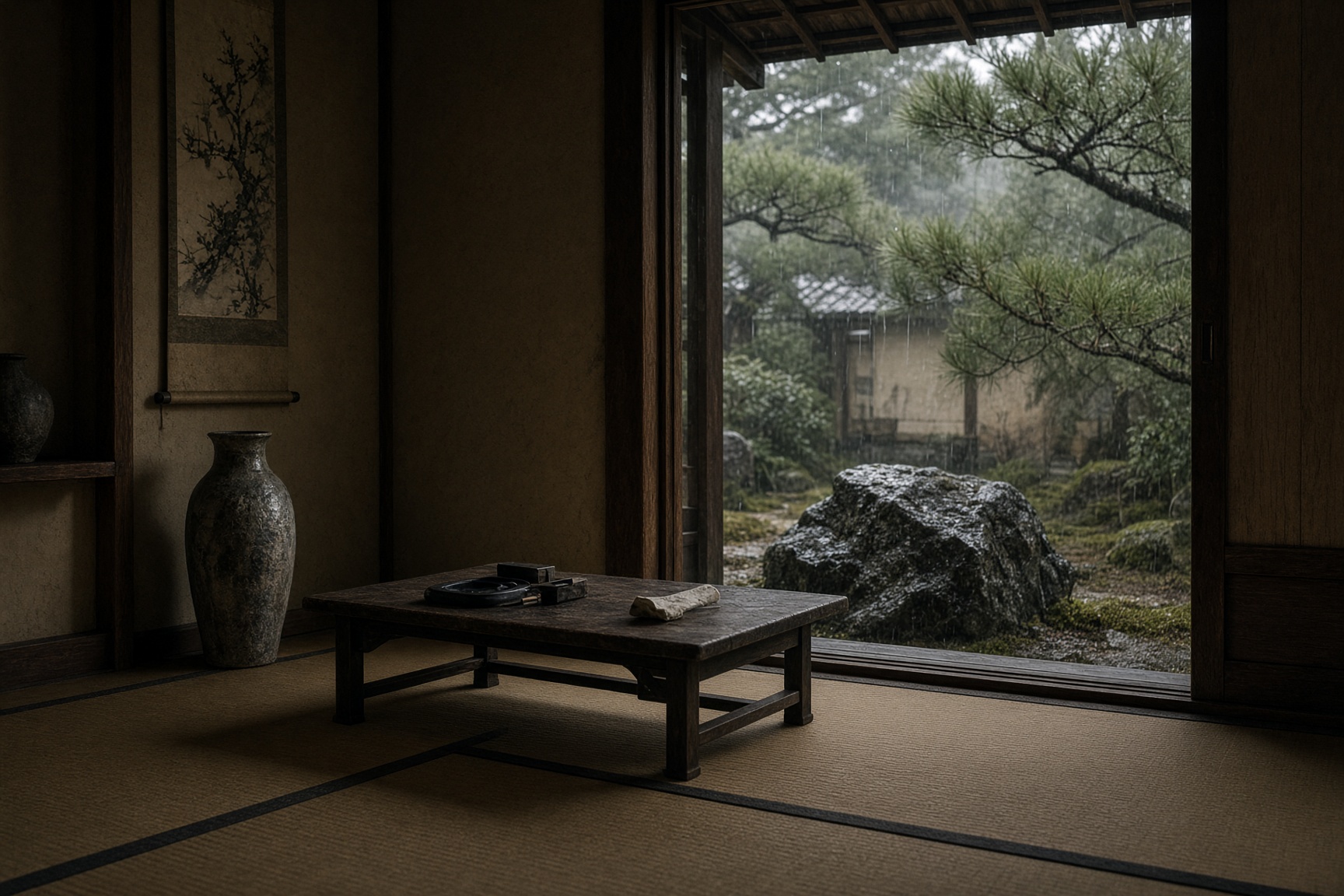
Plate · Generated interpretation
Before I Hear the Bell
A Kyoto philosopher names an experience that is not yet split into hearer and heard.
- Kyoto, on the page
- Late Meiji / early Taishō Japan
- 35.03°N 135.78°E
Do not yet split the rain from the one who would hear it.
Listen · Eve
0:00 / —:—
Kyoto, 1911. Nishida Kitarō, born 1870 near Kanazawa, has spent years as a high-school teacher. In 1910 he is appointed to Kyoto Imperial University. The next year he publishes Zen no kenkyū (An Inquiry into the Good). Before one can say “I hear a sound,” he argues, there is the hearing. Junsui keiken, pure experience: not morally pure, not a souvenir of satori, but the event not-yet-divided into subject and object. Later teaching in his school will often use a bell. Later he will speak of basho, place. This first book is already a refusal of a sealed subject facing objects.
The book sold. It is not a Zen manual, though the later Kyoto School lives near that conversation. William James’s pure experience is a cousin Nishida had read. The Japanese argument is not a translation of James. Dōgen’s mountains are another neighbor, not the same walk.
Zen no kenkyū, 1911. Masao Abe and Christopher Ives, Yale, 1990. Stanford Encyclopedia, “Nishida Kitarō.” Basho is later. Do not read the 1911 book as the mature logic of place.
English “mystical” is a poor host. The risk of the book is grammatical: whether the undivided event can be claimed in a sentence without already dividing it. A sound, a color, a bell in later teaching: once you can say “I hear,” the pure has already become a report.
Pure is not morally pure. It is not-yet-divided. A Japanese first philosophy is not an American psychology, and not a Zen product.
Whether the undivided event can be claimed without already dividing it is the book’s risk.
A word
junsui keiken
Japanese. Pure experience. Not a souvenir of satori.
Distant echoes

Echo
Gilded Age America · Cambridge, Massachusetts
The stream of thought
James also wanted a before of subject and object. Nishida makes it the first philosophy.
Echo
Third-century Roman Empire · Rome, of the seminars Porphyry later edited
The flight of the alone
Plotinus wants the end of seer and seen. Nishida wants the event before I and bell. Two undividings, two systems.
One question remains
Self · Who or what is having the experience?
If there is experience before I and bell, what is using the word I when the sentence returns?