
Science · Perception · 1867
Unconscious Conclusions
A physiologist argues that seeing is already a kind of reasoning we do not feel ourselves do.
- Heidelberg, then Berlin, on the page
- Nineteenth-century German science
- 49.41°N 8.69°E
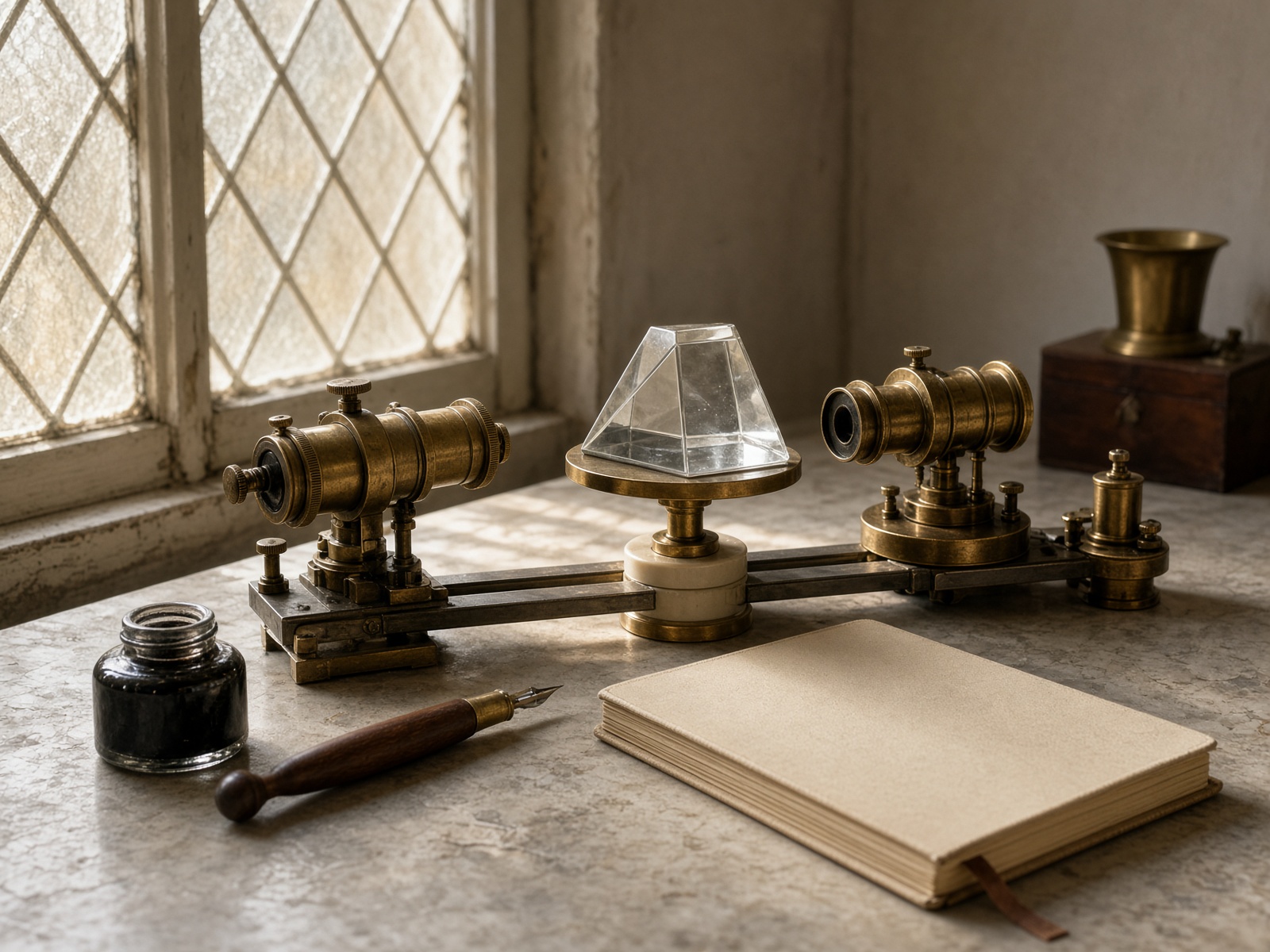
Plate · Generated interpretation
Follow the path from window to brass. Where does the seeing seem to happen?
Listen · Eve
0:00 / —:—
Hermann von Helmholtz, Handbuch der physiologischen Optik (1867), develops unbewusster Schluss: unconscious inference. The retinal image underdetermines the world. The nervous system concludes. You do not watch yourself conclude.
Handbuch der physiologischen Optik. Southall’s English translation (Optical Society of America, 1924–25) is a common door. The phrase is Helmholtz’s, inside a handbook of optics, not a mystery tract.
Predictive processing later claims a descendant. That is a genealogy some scientists like. It is not Helmholtz’s own continuation. The 1867 claim is already large: perception is not a copy.
Unconscious here is not Freud’s unconscious. It is unfelt inference. Mixing the two is a category error.
If seeing is concluding, who, if anyone, is the reasoner?
Distant echoes
Echo
Late twentieth-century science of mind · Tucson, Arizona
The hard part
Helmholtz fills in the world. Chalmers asks why the filling is like something. They can sit together.
One question remains
Perception · What does sensing give us?
If you never feel the inference, is it still yours?