
Portrait · Knowledge · c. 1190
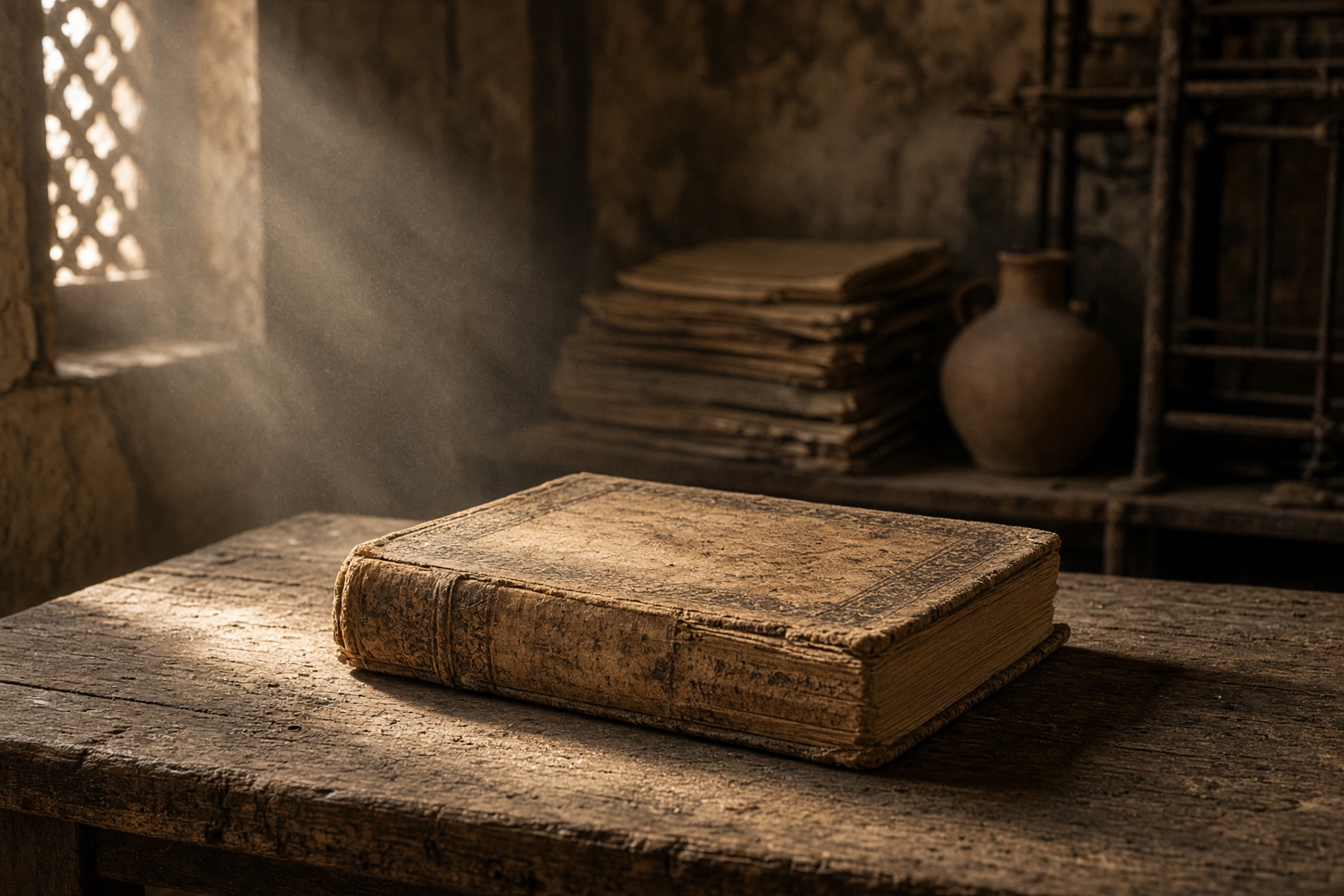
Plate · Generated interpretation
For Those Who Are Perplexed
A physician in Fustat writes a guide for readers caught between philosophy and the Law. The mind has to know how not to smash one with the other.
- Fustat (Cairo)
- Twelfth-century Egypt
- 30.01°N 31.23°E
A closed book. What may not be said?
Listen · Eve
0:00 / —:—
Fustat, near Cairo, the 1180s. Moses Maimonides, Mūsā ibn Maymūn, physician to the Ayyubid court, writes in Arabic with Hebrew letters to a student, Joseph ben Judah, who is caught between the philosophy he has learned and the Law he will not abandon. The book goes out part by part. It is Dalālat al-ḥāʾirīn, The Guide of the Perplexed. Perplexity, here, is not a mood. It is an honorable state of a trained mind that will not smash one inheritance with the other.
Maimonides was born in Córdoba in 1138, fled the Almohads, and made a life in Egypt as judge, physician, and writer. The Mishneh Torah is another work, a code of law, not this book. The Guide is a letter that became a book, in Judeo-Arabic, for someone who already knows too much to be simple and not enough to be at rest. Negative attributes: of God one speaks more truly by saying what God is not. This is not atheism. It is a discipline of speech, so that the mind does not make an idol out of its best sentence.
The Guide of the Perplexed. Shlomo Pines’s English (Chicago, 1963) is a standard door. Sefaria holds a public English. The work is not the Mishneh Torah. Joseph ben Judah of Ceuta is the named addressee.
The Cloud of Unknowing will, in another century and language, also unsay. They are not one apophatic. One is a rabbinic philosopher in Ayyubid Egypt, writing for a student of Aristotle and Torah. One is an English contemplative telling a student to forget even holy thoughts. They can sit on the table. They do not agree by being placed there.
Perplexity here is an honorable state of a trained mind, not a crisis to be soothed. Later readers will fight over how far the unsaying goes, and over whether the Guide’s secrets are for philosophers only. Those fights are the book’s afterlife. They are not why it was sent, part by part, to Joseph.
Whether a mind can know a God it cannot describe is the Guide’s open ridge.
Distant echoes
Echo
Abbasid / Seljuk world · Baghdad, then Damascus and Tus
When knowledge would not sit still
Ghazālī and Maimonides both write after philosophy has unsettled inherited speech. They do not write the same book.
Echo
Fourteenth-century England · The Midlands, on the page
A cloud of forgetting
Two unsayings. One is a rabbinic guide for the perplexed. One is an English cloud. They can sit on the table.
One question remains
Knowledge · What counts as knowing?
If the truest speech is unsaying, what is the knowing that remains?